
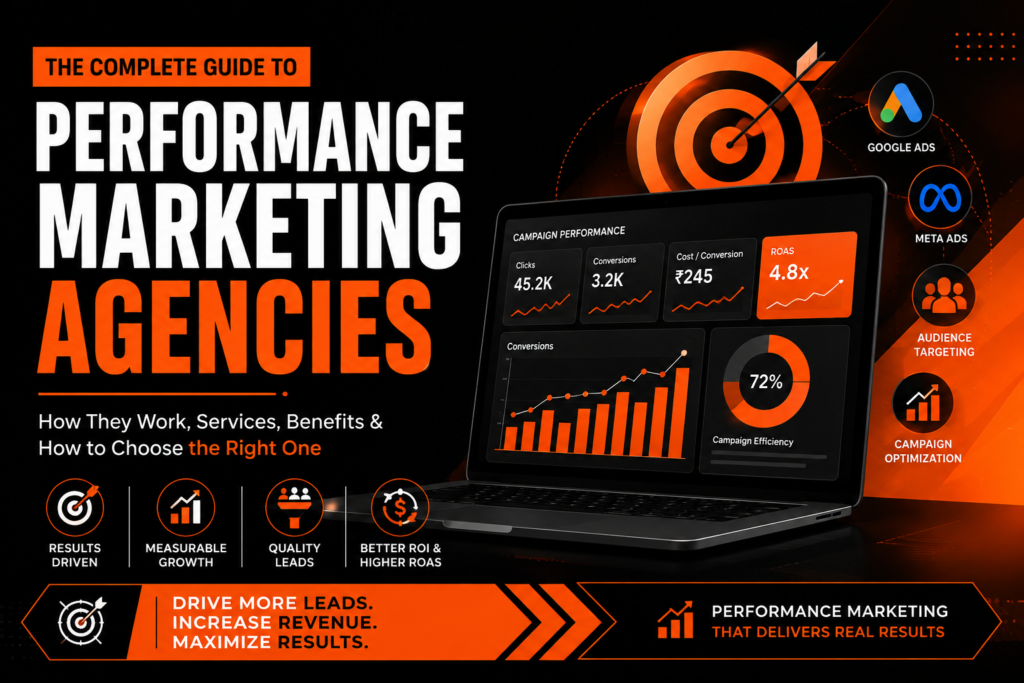
Most marketing budgets used to be judged on reach — how many people saw the ad, how many clicks it got. That’s changed. Founders and CMOs now want to know exactly what a rupee spent on marketing turned into: a lead, a sale, a signup. That shift in expectation is the entire reason performance marketing agencies exist, and why more businesses are hiring them instead of traditional creative or branding shops.
This guide breaks down what these agencies actually do, how they’re priced, and how to tell a genuinely good one from an agency that’s just good at selling itself.
What Is a Performance Marketing Agency?
A performance marketing agency is a firm that runs paid campaigns — Google Ads, Meta Ads, LinkedIn Ads, and similar channels — with the explicit goal of driving a measurable outcome: a lead, a purchase, a signup, a demo booking. Instead of billing for “brand awareness” or “impressions,” the agency’s work is judged against numbers you can put in a spreadsheet.
The core difference from traditional marketing is accountability. A traditional agency might promise a compelling campaign concept. A performance marketing agency promises — and tracks — a cost per lead, a return on ad spend, or a conversion rate, and adjusts the campaign weekly based on what the data shows.
To do that, agencies rely on tracking pixels, conversion APIs, and analytics platforms to attribute every rupee spent to an outcome. Common KPIs include cost per acquisition (CPA), cost per lead (CPL), return on ad spend (ROAS), and conversion rate. If a campaign isn’t hitting agreed targets, it gets paused, rebuilt, or reallocated.
What Does a Performance Marketing Agency Do?
The day-to-day work spans several disciplines, all pointed at the same goal: more conversions per rupee spent.
Paid Advertising
This is the foundation — running and managing campaigns across Google Ads (Search, Display, Performance Max), Meta Ads (Facebook and Instagram), and LinkedIn Ads for B2B audiences, including bidding strategy, budget allocation, and audience targeting.
Lead Generation
Beyond just running ads, agencies build the systems that capture and qualify leads — forms, lead magnets, CRM integrations — so leads coming in are sales-ready, not just names on a spreadsheet.
Conversion Rate Optimization (CRO)
Traffic is only useful if it converts. Agencies test landing pages, forms, and checkout flows to reduce friction — often the single highest-leverage lever in a campaign’s performance.
Tracking & Analytics
Every serious performance campaign runs on clean tracking: conversion pixels, server-side tracking, UTM structures, and dashboards tying ad spend directly to revenue. Without this, “performance” marketing is really just a guess. If you’re still figuring out which platforms to use for this layer of the stack, our guide to digital marketing tools for beginners and experts covers the free and paid options worth knowing.
Creative & Ad Testing
Ad creative decays fast. Agencies continuously test new hooks, formats, and angles to keep cost per result from creeping up.
Campaign Scaling
Once a campaign proves profitable, the job shifts to scaling it without breaking the unit economics — watching CPA, ROAS, and conversion rate closely as budgets increase, since what works at a small spend doesn’t always hold at a much larger one.
Performance Marketing Services Agencies Typically Offer
| Service | What It Includes | Main Goal |
|---|---|---|
| Google Ads | Search, Display, Shopping, Performance Max campaigns | Leads / Sales |
| Meta Ads | Facebook & Instagram campaign management | Leads / Sales |
| LinkedIn Ads | B2B lead generation, sponsored content | Qualified B2B leads |
| CRO | Landing page and funnel optimization, A/B testing | Higher conversion rate |
| Analytics & Tracking | Conversion tracking, attribution, reporting dashboards | Better decisions |
| Retargeting | Remarketing to site visitors and cart abandoners | Recover lost conversions |
Performance Marketing vs Traditional Digital Marketing
Both fall under the broader umbrella of digital marketing, but they optimize for different things.
| Performance Marketing | Traditional Digital Marketing | |
|---|---|---|
| Primary objective | Measurable conversions | Brand awareness, reach |
| Key metrics | CPA, ROAS, conversion rate | Impressions, reach, engagement |
| Optimization cadence | Weekly or daily | Monthly or campaign-based |
| Accountability | Tied directly to results | Harder to attribute to revenue |
| Typical channels | Paid search, paid social, retargeting | TV, print, organic social, PR |
| Budget flexibility | Shifts quickly based on data | Usually fixed for campaign duration |
Neither approach is strictly “better” — a strong marketing mix often uses both. But if your priority is measurable growth on a defined budget, performance marketing is built for exactly that.
What Is Performance-Based Marketing?
“Performance marketing” and “performance-based marketing” get used almost interchangeably, but the second term specifically refers to how the agency is paid: fees tied to actual results rather than a flat fee for time and effort.
Not every performance marketing agency runs on a pure performance-based model. In practice, agencies use a mix of pricing structures:
- Retainer — fixed monthly fee for ongoing management
- Project-based — flat fee for a defined scope
- Percentage of ad spend — scales with media budget, commonly 10–20%
- Performance-based — tied to agreed outcomes like cost per qualified lead
- Hybrid — a base retainer plus a smaller performance bonus
Pure performance-based marketing works best when attribution is clean and the agency has real control over the variables that drive conversions. When attribution is messy — long sales cycles, multiple touchpoints, offline closing — hybrid models tend to be fairer to both sides.
How to Choose the Best Performance Marketing Agency
There’s no single agency that’s objectively “the best” — the right fit depends on your industry, budget, and goals. When evaluating options, look for:
- Relevant industry experience in your space
- Real case studies with actual before/after numbers, not just logos
- Tracking capabilities they can explain clearly
- Reporting transparency — raw dashboard access, not just a monthly slide deck
- Communication — direct access to whoever runs your account
- Pricing model fit for your risk tolerance and budget
- Understanding of your business goals, not just your ad budget
- In-house creative capabilities for testing new ad variations
- Proven ability to scale accounts from small to large budgets
- A structured testing methodology, not an ad-hoc one
Among the many self-proclaimed best performance marketing agencies, the ones worth shortlisting can answer these questions specifically — with numbers — rather than in vague marketing language.
Performance Marketing Agency for B2B Businesses
A B2B performance marketing agency deals with a different problem than a B2C-focused one. Sales cycles are longer, deal sizes are bigger, and a single lead might involve several stakeholders before it closes. For B2B, agencies typically focus on:
- LinkedIn Ads for targeting by job title, company size, and industry
- Google Search Ads for high-intent, bottom-of-funnel queries
- Lead qualification, so sales teams only work real opportunities
- CRM integration with tools like HubSpot or Salesforce, tracking leads through to closed revenue
- Cost per qualified lead rather than raw cost per lead
- Pipeline and revenue attribution, tying ad spend back to deals won weeks or months later
Because B2B sales cycles stretch out, a good B2B agency won’t judge success purely on cost per click — it’ll track leads through the full pipeline.
How Much Do Performance Marketing Agencies Cost?
Pricing varies by agency size, scope, and geography, but most engagements fall into a few common structures:
| Pricing Model | How It Works | Best For |
|---|---|---|
| Monthly Retainer | Fixed monthly fee for a defined scope | Ongoing, predictable management |
| Percentage of Ad Spend | Typically 10–20% of monthly media budget | Paid advertising-heavy accounts |
| Project-Based | Fixed fee for a specific deliverable | One-off campaigns or audits |
| Performance-Based | Fee tied to agreed outcomes (e.g., cost per lead) | Accounts with clean attribution |
| Hybrid | Base retainer plus a smaller performance bonus | Most growth-stage businesses |
Retainers can range from a few thousand rupees a month for a boutique setup to well into six figures for full-scale, multi-channel programs — and that fee sits separately from the ad spend itself. Always confirm whether a quote includes media spend or sits on top of it.
Key Metrics to Measure Agency Performance
- ROAS — revenue generated per rupee of ad spend
- CPA — total cost to acquire one customer
- CPL — cost to generate one lead
- CAC — full cost of acquiring a customer, including agency fees
- Conversion Rate — percentage of visitors who take the desired action
- CTR — how often people click your ad after seeing it
- CPC — average cost of a single click
- Customer Lifetime Value (LTV) — useful for judging whether a high CAC is actually fine
Red Flags to Watch for When Hiring a Performance Agency
- Guaranteed results that sound too good to be true
- No willingness to share raw dashboard access
- Vague or missing conversion tracking setup
- Reports that only mention impressions and clicks, never revenue
- No structured testing process for creative or landing pages
- No clearly agreed KPIs before the campaign starts
- Long lock-in contracts with no reviewable deliverables
- Can’t explain, in plain language, where your budget is going
- No case studies or proof of past work
Frequently Asked Questions
What is a performance marketing agency?
An agency that runs paid campaigns to drive measurable outcomes — leads, sales, or signups — and is judged on metrics like CPA and ROAS rather than brand awareness.
What does a performance marketing agency do?
It manages paid advertising, lead generation, CRO, tracking and analytics, creative testing, and campaign scaling — all aimed at improving return on ad spend.
How does performance-based marketing work?
Agency fees are tied partly or fully to agreed results, such as cost per qualified lead, rather than a flat fee for time spent. It requires clean attribution to work fairly.
How much does a performance marketing agency cost?
Most charge a monthly retainer, a percentage of ad spend (commonly 10–20%), a project fee, or a hybrid. Ad spend is almost always billed separately from agency fees.
How do I choose a performance marketing agency?
Look at relevant case studies, ask how they track and report results, confirm their pricing model fits your budget, and make sure they understand your business goals.
What is the difference between digital marketing and performance marketing?
Digital marketing is the broader category — SEO, social, content, email, and paid ads. Performance marketing is a subset focused on paid, trackable campaigns optimized for conversions.
Conclusion
Performance marketing agencies exist because businesses want proof, not promises — a clear line between marketing spend and actual revenue. Understanding what these agencies do, how they charge, and how to evaluate them puts you in a much better position when comparing proposals.
Whether you’re a growing B2B company or an e-commerce brand trying to scale profitably, the right agency isn’t the one with the flashiest pitch deck — it’s the one that can show clean data, a clear testing process, and results you can actually verify.