
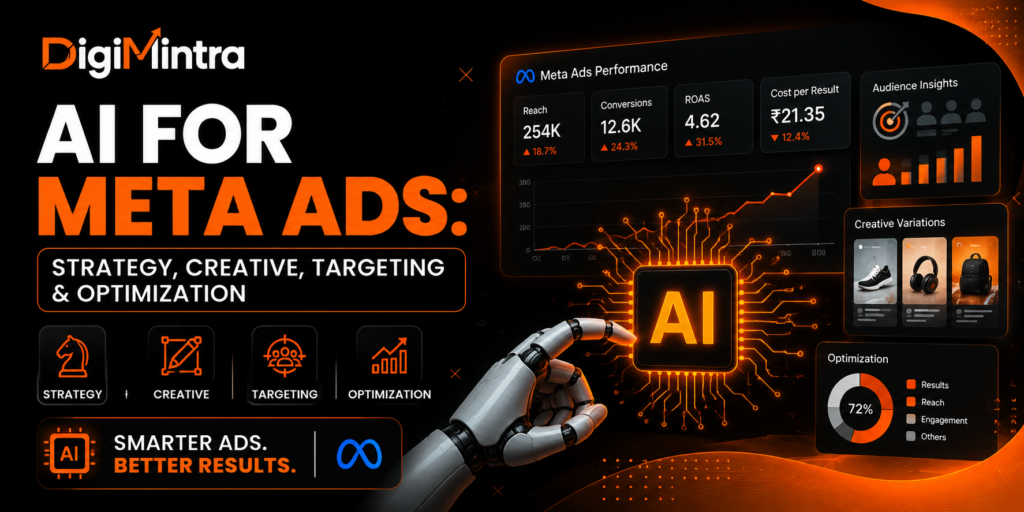
Meta Ads used to be a game of manual levers — pick an interest, pick a placement, write three ad variations, check back in a week. That game is mostly over. Through 2025 and into 2026, Meta rebuilt the entire ad-delivery pipeline around AI systems that decide who sees an ad, what that ad looks like, and how budget gets spent — often with less advertiser input than ever before.
This isn’t a listicle of AI tools. It’s a practical look at how AI for Meta Ads actually works in 2026: what Meta’s systems do on their own, what still needs a human, and how to build a workflow that takes advantage of the automation without losing control of your results.
What Is AI for Meta Ads?
AI for Meta Ads refers to the machine learning and generative AI systems — built into Meta’s own ad platform and layered on top by third-party tools — that handle audience targeting, creative generation, delivery, and budget optimization automatically. Instead of manually selecting interests and placements, advertisers now provide business goals, conversion signals, and creative assets, and Meta’s systems decide the rest.
The Shift: From Manual Media Buying to an AI-Run Auction
The old workflow put the advertiser in the driver’s seat for nearly every decision. The current one flips that:
| Area | Manual Approach (Old) | AI-Driven Approach (2026) |
|---|---|---|
| Targeting | Manual interest selection | Advantage+ Audience, signal-based discovery |
| Placements | Manually chosen | Automated across Feed, Reels, Stories, Audience Network |
| Creative | A handful of manual variations | AI-generated and AI-enhanced variations at scale |
| Budget | Manually allocated per ad set | Algorithmic allocation across the campaign |
| Optimization | Manual daily checks | Continuous, automated delivery optimization |
The advertiser’s job hasn’t disappeared — it’s moved upstream, into strategy, creative direction, tracking quality, and measurement.
Where AI Still Belongs to the Advertiser: Strategy
Before any campaign touches Ads Manager, AI tools like ChatGPT or Claude can speed up the research that used to eat a day of prep work — summarizing customer reviews to find recurring language, drafting competitor ad angle comparisons from public ad libraries, or outlining funnel and messaging hypotheses to test. This is genuinely useful groundwork.
What AI shouldn’t decide on its own: the offer itself, the brand’s positioning, or which customer problem actually matters most. Those calls set the direction everything downstream — creative, targeting, optimization — gets measured against. Treat AI here as a fast research assistant, not a strategist.
Inside Meta’s Ad Delivery System: Andromeda, Lattice, and GEM
Three AI systems now decide which ad you see and when. Understanding them, at least at a high level, explains a lot of what feels unpredictable about Meta Ads right now.
Andromeda is Meta’s retrieval engine. When someone opens Instagram or Facebook, Andromeda scans millions of eligible ads and narrows them down to a shortlist in milliseconds, based on the person’s behavior and the ad’s creative signals — not just the audience you selected.
Lattice handles ranking within that shortlist, predicting outcomes like click and purchase likelihood using one unified model instead of separate models per objective.
GEM — Meta’s Generative Ads Recommendation Model — is the system behind both. Meta’s engineering team described GEM as the largest foundation model built for recommendation systems in the industry, trained at LLM scale. Meta has reported measurable gains from these systems — around a 6% conversion lift on Instagram and 3% on Facebook — and continues to expand GEM’s training scale.
What this means practically: your ad’s creative quality now influences whether it even gets considered, not just how it performs once shown. A great offer with weak creative may never make it through retrieval.
AI-Generated Creative: Advantage+ Creative and Muse Image
Meta’s Advantage+ creative tools generate and enhance ad variations directly inside Ads Manager — expanding images to fit different placements, generating new backgrounds, writing text variations, and converting static images into short videos. Some of these are toggled on by default at the ad level, which means your live creative may already differ from what you originally uploaded unless you review the settings.
Meta added a new layer to this in July 2026 with Muse Image, its first in-house image-generation model from Meta Superintelligence Labs. Meta has said Muse Image will begin powering image generation inside Advantage+ Creative “in the coming weeks” — worth noting this is a rolling deployment, not something every advertiser will see immediately.
It’s worth separating two different things:
- AI-generated creative — new assets produced from a prompt or an existing image, like background swaps or generated variations.
- AI-assisted creative optimization — the system choosing which of your existing creative combinations to show and to whom.
Both are useful, but neither replaces the strategic work of deciding what the ad should actually say. AI can produce dozens of headline variations; it can’t decide which value proposition matters most to your customer. That’s still a human call — and Meta’s own guidance on Advantage+ creative recommends previewing generated variations before they run, particularly for detail-heavy or compliance-sensitive products.
AI-Driven Targeting: Signals Over Selection
Manual interest targeting hasn’t disappeared, but it’s no longer the primary lever. Advantage+ Audience is now the default targeting mode for most campaign objectives, and Meta’s systems actively favor broad targeting backed by strong signals over narrow, manually restricted audiences.
The signals that matter most:
- Meta Pixel — tracks on-site behavior and conversion events
- Conversions API (CAPI) — sends server-side event data, improving reliability as browser tracking gets restricted
- Customer lists and first-party data — feed the system with your existing customer profile
- Exclusions — still useful for keeping ads away from existing customers or irrelevant segments
This doesn’t make manual targeting completely obsolete. Tightly scoped B2B audiences, geographic restrictions, or exclusion lists still have a role — but the core principle has flipped: instead of trying to define the perfect audience yourself, you feed Meta’s system strong signals and let it find people more likely to convert.
AI-Powered Optimization: What to Actually Monitor
Automation handles delivery, placement, and budget allocation — but “automated” doesn’t mean “unsupervised.” Advantage+ Sales campaigns now include value-based bidding, using predicted lifetime value (pLTV) to prioritize buyers likely to spend more, not just convert once.
What marketers should still track closely:
- CPA and CPL — cost per acquisition and per lead
- ROAS — return on ad spend
- Conversion rate and frequency — watch for creative fatigue as frequency climbs
- Lead quality — a cheaper lead isn’t a win if it doesn’t convert downstream
If a campaign underperforms, the fix is rarely to manually override the algorithm mid-flight. It’s usually to feed it better creative, cleaner conversion signals, or a clearer optimization event.
Tools for AI-Powered Meta Ads in 2026
| Tool / Feature | Category | Best For |
|---|---|---|
| Advantage+ (Andromeda, Lattice, GEM) | Meta native | Core delivery, targeting, and budget automation |
| Advantage+ Creative / Muse Image | Meta native | AI-generated and AI-enhanced ad variations |
| AdCreative.ai | Third-party | High-volume static/video creative generation |
| Motion | Third-party | Creative-level performance analytics |
| Madgicx | Third-party | Meta-specific optimization and audience insights |
| Revealbot | Third-party | Rule-based budget and bid automation |
| Foreplay | Third-party | Ad research and creative brief-building |
Third-party tools sit on top of Meta’s own automation rather than replacing it — they help you produce, analyze, or enforce rules around the creative and budget decisions Meta’s systems are already making.
A Practical Creative Testing Framework
AI can generate volume; it can’t decide what’s worth testing. A structured framework keeps testing meaningful:
- Hook: problem-led vs. benefit-led vs. curiosity-led opening
- Format: UGC vs. static product shot vs. founder-led video
- Message: price vs. outcome vs. pain point vs. social proof
- CTA: Shop Now vs. Learn More vs. Get Quote
Let AI generate the variations within each variable. Humans should still decide which variables are worth testing for a given product and audience — ten near-identical AI variations of the same angle rarely produce a new insight.
Illustrative Example: Before and After AI-Assisted Setup
The table below is a hypothetical scenario for an e-commerce brand shifting from manual to AI-assisted campaign management — illustrative only, not a real client result.
| Metric | Manual Setup | AI-Assisted Setup |
|---|---|---|
| Audiences | 6 manual interest sets | 1 broad Advantage+ audience |
| Creative variations | 3 | 10–12 |
| Optimization | Manual daily checks | Automated + weekly human review |
| Illustrative CPA change | Baseline | Lower, with more variance week to week |
AI vs. Human: Who Should Own What
| Task | AI | Human |
|---|---|---|
| Creative variations | Strong | Final approval |
| Audience discovery | Strong | Strategic direction |
| Delivery optimization | Strong | Monitoring |
| Brand positioning & offer | Assist | Lead |
| Quality control | Limited | Essential |
AI increases leverage — it shouldn’t replace judgment about what the brand should say and to whom.
Common Mistakes When Using AI for Meta Ads
- Publishing AI-generated creative without reviewing it first
- Generating dozens of near-identical variations instead of testing genuinely different angles
- Running campaigns on weak or incomplete conversion tracking
- Changing campaign settings too frequently, resetting the learning phase
- Optimizing for cheap clicks instead of actual revenue or lead quality
- Ignoring creative fatigue as frequency climbs
- Treating AI as a substitute for strategy rather than an accelerant of it
Frequently Asked Questions
What is AI for Meta Ads?
It’s the set of machine learning and generative AI systems inside Meta’s ad platform — like Andromeda, Lattice, GEM, and Advantage+ — that handle targeting, creative variation, and delivery optimization automatically.
Can AI create Meta ad creatives?
Yes. Advantage+ Creative can generate backgrounds, text variations, and image expansions, and Muse Image is rolling into that toolset in 2026 — but human review is still recommended before variations go live.
Does Meta use AI for ad targeting?
Yes. Advantage+ Audience is now the default targeting mode for most objectives, using behavioral and conversion signals rather than manually selected interests.
What signals matter most for AI optimization?
Clean Meta Pixel and Conversions API data, quality conversion events, and first-party customer data — better signals give the AI more to optimize against.
Will AI replace Meta Ads managers?
Not the role itself. It shifts the work toward strategy, creative direction, tracking quality, and measurement, while AI handles execution-level decisions.
How can beginners start using AI for Meta Ads?
Start with a well-tracked Advantage+ campaign, provide 8–10 genuinely different creative variations, and review performance weekly rather than daily.
Conclusion
The competitive line in Meta advertising isn’t AI versus marketers — it’s marketers who know how to work with Meta’s AI systems versus those who don’t. The systems now handle targeting, delivery, and a growing share of creative production. What still separates strong accounts from weak ones is strategy, creative input quality, clean tracking, and disciplined testing — the parts AI still can’t do on its own.
If you’re building out your paid social strategy alongside Meta Ads, it’s also worth reading how performance marketing agencies structure their approach to Meta and Google campaigns, and which digital marketing tools are worth adding to your stack.