
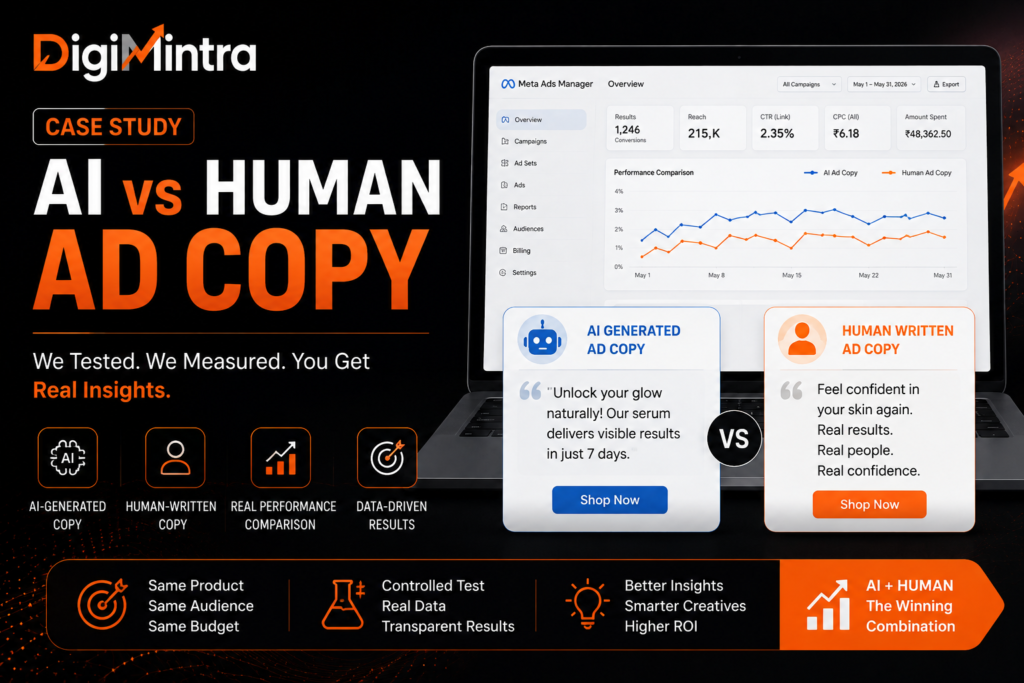
Ask most marketers whether AI can write ad copy as well as an experienced human, and you’ll get a confident answer — usually the wrong kind of confident, because it’s based on a handful of anecdotes rather than actual testing. In 2026, that gap has started to close. Several large, methodologically serious studies have now tested AI-generated advertising copy against human-written copy under real or near-real conditions. The results don’t hand a clean win to either side — and that’s exactly what makes them useful.
This is a look at what that evidence actually shows, followed by a testing methodology you can run in your own Meta Ads account to find your own answer.
What the Research Actually Found
Four separate studies published between late 2025 and mid-2026 tested AI-generated versus human-written ad creative under controlled or large-scale field conditions. None of them agree completely with each other — which is itself the most important finding.
The largest, published in January 2026, came from a collaboration between Taboola and researchers at Columbia, Harvard, the Technical University of Munich, and Carnegie Mellon. They analyzed live ads on Taboola’s Realize platform across more than 500 million impressions and 3 million clicks. In raw data, AI-generated ads posted a 0.76% average CTR versus 0.65% for human-made ads — though the gap narrowed once the researchers applied tighter statistical controls. The more interesting finding: AI ads that didn’t visually “look like AI” achieved the highest engagement of any group in the study, outperforming both obviously-AI ads and human-made ads. A large, clear human face in the creative was one of the strongest predictors of that trust signal.
A separate study from NYU Stern and Emory’s Goizueta Business School, published in December 2025, tested three conditions: fully human-made ads, human ads enhanced by AI, and fully AI-generated ads — across more than 105,000 real impressions. The fully AI-generated ads won, outperforming human-made ads by up to 19% on click-through rate. Notably, the human-plus-AI hybrid did not beat either pure condition, complicating the easy assumption that “AI-assisted” always beats “AI-only.”
A third study, from Ipsos and Syracuse University’s Newhouse School, took a different approach: pairing 20 existing human-made ads (produced before 2021, so AI tools couldn’t have touched them) with AI-generated counterparts built from the same strategic brief, then testing both with 3,000 U.S. respondents. Here, human-made ads outperformed AI on predicting short-term sales impact — though the researchers described the gap as “surprisingly slim.”
A fourth, more rigorous academic field experiment ran real ad campaigns on X, comparing human-AI teams against human-human teams across 400 campaigns and roughly 4.9 million impressions. It found that human-AI teams produced higher-quality text but lower-quality images than human-human teams — and the two effects roughly canceled out, leaving overall performance similar between the two team types.
Study Comparison at a Glance
| Study | Sample | Headline Finding |
|---|---|---|
| Taboola / Columbia / Harvard / TUM / CMU (Jan 2026) | 500M+ impressions, 3M clicks, live campaigns | AI ads slightly higher CTR; advantage driven by ads that don’t “look like AI” |
| NYU Stern / Emory Goizueta (Dec 2025) | 105,000+ impressions, field test | Fully AI-generated ads beat human ads by up to 19% CTR; hybrid underperformed both |
| Ipsos / Syracuse Newhouse (May 2026) | 20 ads, 10 brands, 3,000 respondents | Human-made ads edged ahead on predicted short-term sales impact |
| Academic field experiment on X | 400 campaigns, ~4.9M impressions | Human-AI and human-human teams performed similarly overall — quality trade-offs offset each other |
What This Actually Means: Attention vs. Intent
Read across all four studies, a pattern emerges that’s more useful than “AI wins” or “humans win.” AI-generated creative appears to be genuinely strong at generating attention — clicks, engagement, top-of-funnel interest — provided it doesn’t read as visibly synthetic. Where the evidence gets murkier is further down the funnel: predicted sales impact and higher-consideration purchases, where human-made creative still holds an edge in some datasets. One industry benchmark analysis (not an academic study, so treat it as directional) found AI creative’s conversion rate disadvantage widening at higher price points — roughly 8% lower conversion on purchases over $100, and 14% lower over $500 — suggesting the AI-human performance gap isn’t fixed, it moves with how much is being asked of the buyer.
Why “Looking Like AI” Might Be the Real Variable
The most consistent thread across the research isn’t AI versus human as a category — it’s whether the ad reads as authentic regardless of who or what made it. The Taboola study’s clearest finding was that AI ads perceived as artificial underperformed everything else, while AI ads that passed as human-made outperformed everything else, including human-made ads. That reframes the practical question: the goal isn’t “should I use AI,” it’s “does this specific piece of creative feel real to the person seeing it.”
A Testing Methodology You Can Actually Run
Whatever the published research shows in aggregate, your account, audience, and offer are specific to you. Here’s a rigorous way to test AI versus human copy in Meta Ads without confounding the result:
Keep these identical across both versions
- Product and offer
- Target audience and campaign objective
- Landing page
- Budget and bid strategy
- Placements and creative format (image or video)
- Testing period — run both long enough to exit the learning phase
Change only one variable at a time
Don’t test “AI copy” against “human copy” as a single blended variable — test one element at a time so you know what actually moved the number: hook, headline, primary text, CTA, or emotional angle. Changing all of them simultaneously means a win or loss can’t be attributed to anything specific.
Write one version as the baseline
Generate multiple angles from the same brief
Apply brand voice and strategic judgment
Launch, wait for real data, compare outcomes
Metrics That Actually Matter — By Objective
Judging every test by CTR alone is one of the most common mistakes in this kind of comparison. A lead-gen campaign shouldn’t be scored on click-through rate; an e-commerce campaign shouldn’t be scored only on CPC.
| Objective | Engagement Metric (Don’t Stop Here) | Business Outcome Metric (What Actually Matters) |
|---|---|---|
| Lead generation | CTR, link clicks | CPL, lead quality, conversion rate to qualified lead |
| E-commerce | CTR, landing page views | CPA, ROAS, cost per purchase |
| Brand awareness | CTR, engagement rate | View-through rate, assisted conversions downstream |
AI vs. Human Copy: A Practical Comparison
| Factor | AI-Generated Copy | Human-Written Copy |
|---|---|---|
| Speed | Dozens of variations in minutes | Hours to days per variation |
| Volume for testing | High | Limited by time/budget |
| Brand nuance | Needs strong brief and editing | Generally stronger by default |
| Emotional specificity | Can feel generic without guidance | Often stronger on lived customer insight |
| Consistency across channels | High | Depends on the writer |
| Performance on attention metrics | Strong, per multiple 2026 studies | Competitive, sometimes behind |
| Performance on high-consideration purchases | Weaker in some datasets | Holds an edge in some datasets |
Illustrative Example: Running This in Practice
Illustrative example — not a real campaign result. A mid-size e-commerce brand tests an AI-generated hook (“Stop replacing your [product] every 6 months”) against a human-written hook built from actual customer reviews (“I used to buy 3 a year — this one’s lasted since January”). Both run with identical audience, budget, and landing page for two weeks. The AI hook drives a higher CTR; the human hook, drawn from real customer language, converts at a higher rate. Neither result would have been visible without isolating the hook as the only variable.
What We Learned
- AI is strongest at producing volume, testing more angles faster, and matching or beating human copy on attention-based metrics when the output doesn’t read as synthetic.
- Humans remain stronger in some studies at driving higher-consideration purchases and predicting real sales impact, likely because of deeper customer insight and brand judgment.
- Hybrid isn’t automatically better — the NYU/Emory study found human-AI blends underperformed both pure conditions, so editing AI output isn’t a guaranteed upgrade; it depends on what the edit actually changes.
- The real variable is authenticity, not authorship — the strongest predictor across studies was whether the ad felt genuinely human, not who or what wrote it.
- Test one variable at a time in your own account — published research tells you what’s plausible, not what will happen with your specific audience and offer.
Frequently Asked Questions
Is AI-generated ad copy better than human-written copy?
Neither wins consistently. Large-scale studies show AI copy performing as well as or slightly better than human copy on click-through rate, while some research shows human copy holding an edge on predicted sales impact for higher-consideration purchases.
Can AI write effective Meta Ads?
Yes, particularly for generating volume and testing multiple angles quickly. Performance depends heavily on whether the output is reviewed and edited for brand voice rather than published as-is.
How do you test AI vs human ad copy properly?
Hold every variable constant except the copy element you’re testing — same audience, budget, landing page, and format — and change one thing at a time (hook, headline, or CTA) rather than swapping the whole ad.
Does a hybrid AI-plus-human approach always perform best?
Not necessarily. At least one 2025 field study found fully AI-generated ads outperforming a human-edited hybrid, suggesting the value of human editing depends on what specifically gets changed, not editing for its own sake.
What matters more than whether copy is AI or human?
Whether the ad reads as authentic. Research consistently shows ads perceived as artificial underperforming, regardless of source.
Conclusion
The honest answer to “AI vs. human ad copy” isn’t a winner — it’s a set of conditions under which each tends to do better. AI earns its place by generating volume and testing angles fast; humans earn theirs by catching what AI misses about a specific customer, and by editing AI output toward something that doesn’t read as synthetic. The marketers getting the best results in 2026 aren’t choosing a side — they’re running the controlled test in their own account and following whatever the data says for their product.
For more on where AI is heading across Meta’s ad platform, see how AI is changing Meta Ads strategy and targeting, and if you’re weighing whether to add a dedicated AI copy tool to your stack, our guide to the ROI of AI marketing tools walks through how to calculate that before you buy.