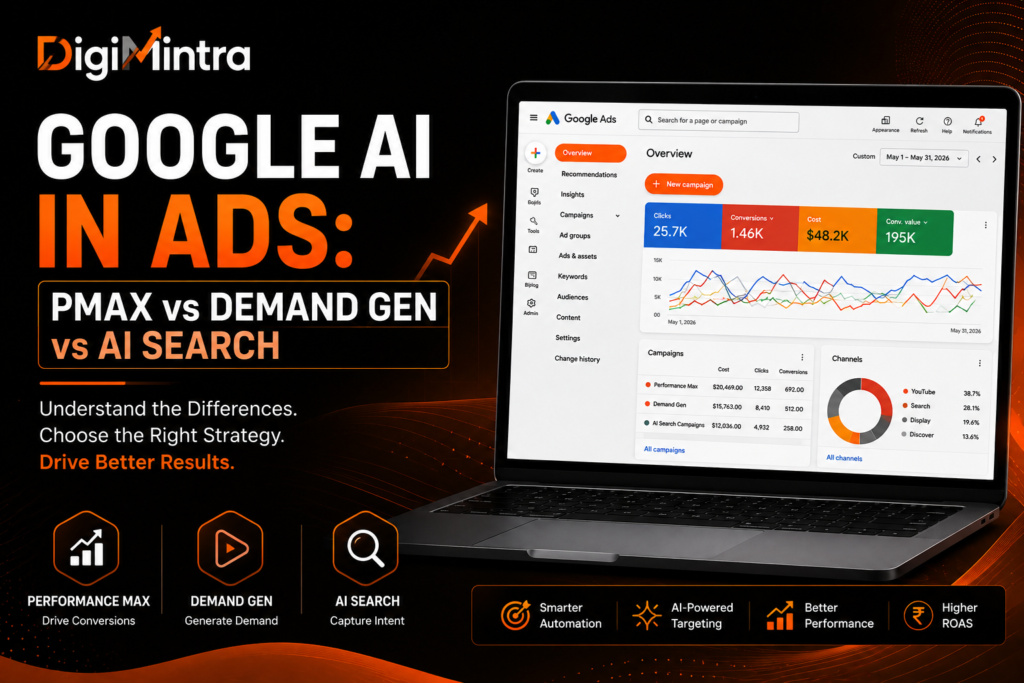
Ask a PPC manager in 2023 which Google Ads campaign to run and the answer was mostly about inventory: Search for intent, Display for reach, YouTube for video. Ask that same question in 2026 and the honest answer is different — it’s not really about inventory anymore, because Performance Max, Demand Gen, and AI Max for Search all now reach overlapping parts of Google’s ecosystem. The real question has become which AI system should make the decisions, based on what data you have and what you’re actually trying to achieve.
This is a practical guide to that question — not a feature list, but a working comparison of the three systems and when each one earns its place in an account.
The Three AI Systems, at a Glance
AI Max for Search is an AI layer added on top of a standard Search campaign — you keep keywords and campaign structure, and AI Max expands reach and generates creative around them. Performance Max is a fully automated campaign type that runs across every Google surface — Search, Shopping, Display, YouTube, Discover, Gmail, and Maps — from one campaign with one conversion goal. Demand Gen is a visual, audience-led campaign type that runs on YouTube, Discover, Gmail, and Display, built to create interest before someone starts searching at all.
PMax vs Demand Gen vs AI Max: The Comparison
| Feature | AI Max for Search | Performance Max | Demand Gen |
|---|---|---|---|
| Foundation | Standard Search campaign + AI layer | Fully automated, standalone campaign type | Standalone, audience-led campaign type |
| Inventory | Google Search + Search Partners | Search, Shopping, Display, YouTube, Discover, Gmail, Maps | YouTube, Discover, Gmail, Display, Maps |
| Targeting basis | Keywords + AI query expansion | Audience signals, no keywords | Audience signals, lookalikes, no keywords |
| Search/Shopping access | Search only | Yes, both | No |
| Creative control | High — you still write the ads, AI expands them | Low — Google assembles asset combinations | Medium — you control creative, AI optimizes rotation |
| Placement transparency | High | Improving but still limited | High — channel-level controls |
| Best funnel stage | Capturing existing intent | Full-funnel, conversion harvesting | Creating and nurturing demand |
| Primary KPI | CPA, conversion rate on search terms | ROAS or CPA (blended, cross-channel) | New customer reach, view-through conversions, assisted conversions |
AI Max for Search: Search Campaigns With an AI Layer
AI Max for Search reached general availability on April 15, 2026 after roughly eleven months in beta, and it’s now the fastest-growing AI feature suite inside Search campaigns. It isn’t a new campaign type — it’s three toggleable features inside your existing Search campaign: search term matching, which uses broad match and keywordless technology to find relevant queries beyond your keyword list; text customization, which lets Google generate headline and description variations; and final URL expansion, which can route a click to a better-matching page on your site than the one you specified.
Google’s own reported figure is that advertisers using the full feature suite see about 7% more conversions or conversion value at a similar CPA or ROAS compared to search term matching alone — a directional number from Google’s internal data, not a guarantee. Independent testing tells a more mixed story: one dataset covering 23 AI Max tests found that a majority of advertisers saw neutral or negative outcomes at the account level, largely because “new” queries were often cannibalized from campaigns the advertiser was already running rather than representing genuinely new demand.
Google is also pushing adoption structurally, not just through opt-in. Starting September 2026, campaigns using campaign-level Broad Match or standalone Automatically Created Assets are being auto-migrated to AI Max. Dynamic Search Ads were originally on the same September timeline but Google pushed that migration back to February 2027 after advertiser pushback, confirmed by Google Ads Liaison Ginny Marvin in June 2026.
Controls worth knowing: up to 25 search themes for directional topic guidance, term exclusions and messaging restrictions to keep AI-generated copy on-brand, and text disclaimers that stay pinned even when final URL expansion is active — useful for regulated industries. AI-generated ad elements now carry a small automated-content label.
Performance Max: Full-Funnel Automation Across All Inventory
Performance Max remains Google’s most automated campaign type — one campaign, one conversion goal, and the algorithm decides bidding, placement, and creative combinations across Search, Shopping, Display, YouTube, Discover, Gmail, and Maps. Its long-standing complaint has been transparency, and that’s the area Google has moved on most through 2026.
Recent additions include channel performance reporting that breaks blended results down by network, a channel performance timeline view, asset-group-level and asset-combination reporting, first-party audience exclusion (so you can stop spending on existing customers), a projected end-of-month budget report, and expanded negative keyword support at the campaign and account level — up to 10,000 terms. Brand guidelines, added in Google Ads Editor 2.12, now support up to 25 term exclusions and 40 messaging restrictions per campaign.
Creative automation has also expanded. Asset Studio, powered by Google’s Imagen and Veo models, can generate images and video variations directly inside Google Ads, and a “Create video” button now lets advertisers generate short video assets from existing images using Veo 3. Note: PMax will auto-generate video and even AI voice-over narration for silent video assets by default unless you opt out at the campaign level — worth checking if brand voice consistency matters to you.
PMax remains strongest for e-commerce and lead gen accounts with enough conversion volume (generally 30+ conversions/month is the practical threshold) for the algorithm to learn from. With too little data, it tends to spend inefficiently while it searches for a pattern.
Demand Gen: Creating Demand Before the Search Happens
Demand Gen is Google’s answer to feed-based social advertising — visual, audience-led campaigns running across YouTube (including Shorts), Discover, Gmail, and, as of June 2026, the Google Display Network as standalone Display campaigns get folded in. It reaches an estimated 3 billion monthly users. Unlike PMax and AI Max, it never touches Search or Shopping — it’s built specifically for the demand-creation and consideration stages, before someone has typed a query.
Targeting runs on audience signals rather than keywords: custom segments, Customer Match lists, and lookalike segments seeded from your best existing customers (Narrow ~2.5%, Balanced ~5%, or Broad ~10% similarity). One nuance worth knowing — since March 2026, lookalike segments function as audience suggestions rather than hard targeting constraints, meaning Google’s AI has more latitude to expand beyond your seed list than it used to.
Demand Gen gives you more real control than PMax: you can restrict which channels it serves on, exclude specific placements, and choose inventory expansion level. Bidding typically starts on Maximize Clicks for the first couple of weeks to gather data, then shifts to Target CPA once you have roughly 30 conversions in a 30-day window. It doesn’t support manual frequency capping at the campaign level, so audience fatigue is something to monitor through impression-to-conversion ratios rather than control directly.
How the Three Fit Together
These aren’t meant to be evaluated as competitors for the same job. A reasonable way to think about the funnel:
Create awareness & interest on YouTube, Discover, Gmail — before intent exists
Capture high-intent queries with full keyword-level transparency
Harvest conversions across every remaining surface with minimal setup
The catch: PMax also has access to Search, which means it can compete with your own AI Max campaigns for the same queries, quietly inflating CPCs and fragmenting your data. If you run both, set brand exclusions at the account level and monitor query overlap — this is one of the most common ways budget gets wasted in 2026 accounts.
Which One Should You Use? A Decision Framework
| Business Type | Reasonable Starting Point |
|---|---|
| E-commerce, established conversion data | PMax for cross-channel harvesting + Demand Gen as a prospecting layer feeding it |
| B2B lead generation | AI Max for Search for high-intent capture + Demand Gen for mid-funnel content offers (webinars, reports) |
| Local service business | AI Max for Search with Locations of Interest, PMax only once there’s enough conversion volume |
| New brand, little historical data | Standard Search first to build a conversion baseline before adding AI Max or PMax |
| D2C brand focused on new-customer growth | Demand Gen with lookalikes from a clean customer list, PMax with audience exclusions to avoid re-targeting existing buyers |
Why Conversion Signal Quality Determines the Outcome
All three systems optimize toward whatever data you feed them — nothing more. Clean Enhanced Conversions, server-side tracking (Google’s own data shows browser-only tracking misses a meaningful share of conversions), accurate conversion values, and first-party or CRM data all directly shape how well AI Max, PMax, and Demand Gen can find the right users. Feed any of them incomplete or low-quality signals and they’ll optimize confidently toward the wrong outcome — this is the most overlooked prerequisite in 2026 Google Ads accounts, and no amount of AI sophistication fixes bad input data.
Illustrative Example: A Mixed Strategy (Not a Real Client Result)
| Campaign | Role | Illustrative Monthly Budget Split |
|---|---|---|
| Demand Gen | New audience reach, lookalike prospecting | 25% |
| AI Max for Search | High-intent query capture | 35% |
| Performance Max | Cross-channel conversion harvesting | 40% |
Frequently Asked Questions
What is AI Max for Search?
An AI-powered feature suite added to standard Search campaigns — covering query expansion, AI-generated ad text, and landing page matching — that reached general availability in April 2026.
What’s the difference between Performance Max and Demand Gen?
Performance Max runs across all Google inventory including Search and Shopping with a single automated conversion goal. Demand Gen runs only on visual, feed-based surfaces — YouTube, Discover, Gmail, Display — and never touches Search or Shopping.
Is Performance Max better than Search?
Neither is universally better — PMax is stronger for broad, cross-channel conversion volume when you already have enough data; standard or AI Max Search campaigns give more transparency and control over high-intent queries.
When should I use Demand Gen?
When you want to build awareness or reach new customers before they start searching — particularly useful as a prospecting layer that feeds later-funnel Search or PMax campaigns.
Can AI Max and Performance Max run at the same time?
Yes, but they can compete for the same Search queries. Use account-level brand exclusions and monitor search term overlap to avoid inflating your own costs.
Will AI replace manual Google Ads management?
Not the strategic role. It’s absorbing execution — bidding, placement, and creative assembly — while advertisers focus more on conversion data quality, budget allocation across campaign types, and measurement.
Conclusion
The advertisers getting the most out of Google’s AI ecosystem in 2026 aren’t picking one winner between PMax, Demand Gen, and AI Max — they’re assigning each system the job it’s actually built for and feeding it clean data. The strategic skill has shifted from manually building campaigns to deciding which AI system deserves which part of the budget, and making sure the signals behind that decision are trustworthy.
If you’re building out a broader AI-driven strategy, it’s worth reading how AI is changing Meta Ads for a cross-platform comparison, or how to calculate the ROI of AI marketing tools before expanding your stack further.