
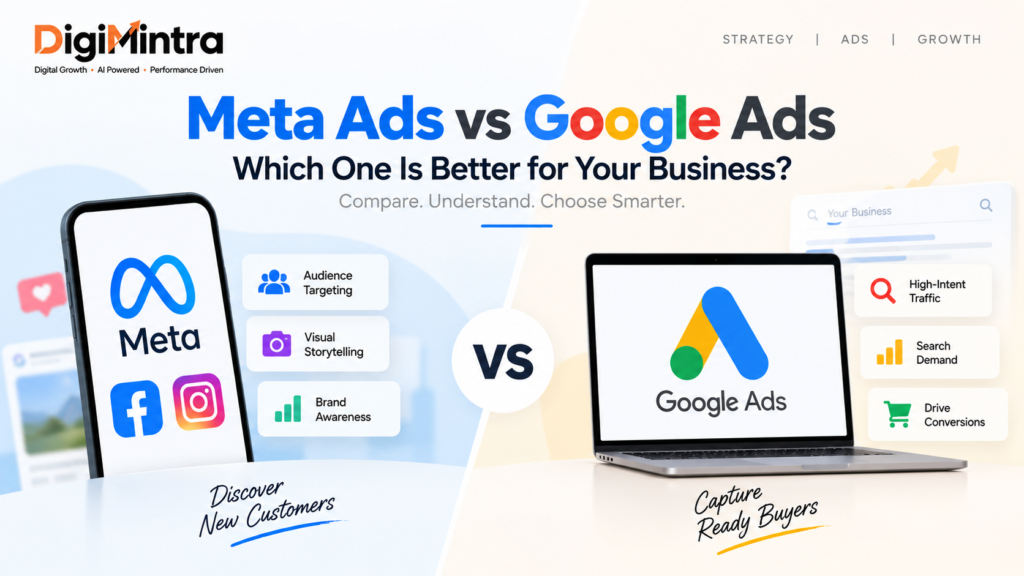
“Meta Ads or Google Ads — which one should I use?” is the wrong first question. The right one is: where does demand for what I sell actually exist right now — in people’s search bar, or in their scroll? Google Ads and Meta Ads aren’t competing products solving the same problem; they sit at different points in how people discover, consider, and buy. Picking between them without knowing which point your business needs is how budgets get wasted on the wrong platform for months.
Short answer: Google Ads tends to work better when people are already searching for what you offer — it captures demand that already exists. Meta Ads tends to work better when you need to create interest in people who weren’t looking for you yet — it generates demand before it exists. Neither is universally better; the right one depends on your product, your customer’s buying behavior, and your budget.
The Core Difference: Capturing Demand vs. Creating It
Consider two very different businesses. An accountant specializing in GST filing for small businesses has customers who actively search — “GST filing consultant near me,” “CA for small business Bangalore” — at the exact moment they need help. That’s demand that already exists, waiting to be captured. A new skincare brand launching a niche product, on the other hand, has no one searching for it by name yet. Nobody wakes up Googling a product they’ve never heard of. That demand has to be created — through a scroll-stopping video, a compelling before/after, a founder story — before a search ever happens.
This is the single most useful lens for the entire decision: Google Ads is built for intent that already exists; Meta Ads is built for intent that has to be built. Almost every other difference between the platforms — targeting method, creative requirements, typical conversion speed — flows from that one distinction.
It also explains why comparing the two platforms on a single metric so often misleads people. A search ad and a feed ad aren’t competing for the same moment in a customer’s day — one interrupts an active search, the other interrupts a scroll. Judging both by the same yardstick is a bit like comparing a shop’s window display to its checkout counter: they serve the same business, but they’re not doing the same job.
How Each Platform Actually Works in 2026
Google Ads now runs largely through AI-driven systems — Performance Max, Demand Gen, and AI Max for Search — that expand reach and automate bidding around your conversion signals, while still fundamentally operating on search intent, product feeds, and audience signals across Search, Shopping, YouTube, Discover, and Gmail. We cover exactly how these systems differ and when to use each in our guide to PMax vs Demand Gen vs AI Max for Search.
Meta Ads has similarly shifted toward AI-driven delivery through Advantage+ campaigns, which handle audience discovery, placement, and creative variation automatically across Facebook, Instagram, Reels, and Messenger — targeting based on interests, behavior, and lookalike signals rather than keywords. Our deep dive on AI for Meta Ads covers how that automation actually works and what still needs human oversight.
Meta Ads vs. Google Ads: A Direct Comparison
| Factor | Google Ads | Meta Ads |
|---|---|---|
| Primary mechanism | Captures existing search intent | Creates interest before intent exists |
| Targeting basis | Keywords, product feeds, audience signals | Interests, behavior, lookalikes, retargeting |
| Best inventory | Search, Shopping, YouTube, Discover, Gmail | Feed, Reels, Stories, Messenger |
| Creative demands | Moderate — text, product images, some video | High — needs scroll-stopping visual/video creative |
| Typical conversion speed | Faster — closer to purchase decision | Slower — often needs multiple touchpoints |
| Strongest for | High-intent local services, B2B, urgent needs | Visual products, new brands, impulse-driven categories |
| Retargeting role | Effective, but smaller addressable pool | Very strong — large scroll-time inventory |
| Automation in 2026 | PMax, Demand Gen, AI Max for Search | Advantage+ campaigns, AI creative tools |
Cost: Why a Direct CPC Comparison Is Misleading
Meta’s CPC is often lower than Google’s — that’s a fair generalization across most industry data. But comparing raw CPC is comparing the wrong number. A cheap Meta click from someone mid-scroll, with no immediate intent, can produce a worse cost per acquisition than a more expensive Google click from someone actively searching to buy. Cost per acquisition (CPA), not cost per click, is the number that tells you which platform is actually working for your business.
For detailed India-specific cost breakdowns, our guides on Google Ads cost in India and Meta Ads budget in India cover current CPC, CPM, and CPL ranges by industry, along with formulas to calculate a realistic starting budget for either platform.
A Practical Decision Framework
Rather than scoring the platforms against each other, work through these conditions against your own business:
- People already search for what you sell, with clear terminology → Google Ads is a natural starting point; you’re capturing demand that’s already there.
- Your product or service has no established search demand yet → Meta Ads may be more useful for generating initial interest before search demand exists.
- The offer is highly visual — appearance, transformation, lifestyle → Meta’s feed and Reels formats are built for this kind of storytelling.
- The purchase is urgent or need-based (“burst pipe,” “lawyer near me now”) → Google Search is where that urgency shows up as a query.
- The sales cycle is long and consideration-heavy (B2B, high-ticket) → Google often captures the eventual research-stage search, while Meta can support earlier-stage nurturing and retargeting.
- You’re a new, unknown brand with no search volume for your name → Consider testing Meta first to build the audience awareness that eventually turns into branded search.
- You need retargeting at scale → Meta’s large scroll-time inventory generally supports more retargeting volume than Google’s remarketing network.
- Your budget is limited and you can only run one platform well → Match it to wherever the stronger source of intent already exists for your specific category, rather than splitting a small budget thin across both.
Which Platform Fits Which Business Type?
| Business Type | Where to Consider Starting | Why |
|---|---|---|
| Local services (plumbers, clinics, salons) | Google Ads (Search) | High-intent, need-based searches with clear local terminology |
| D2C / visual product brands | Meta Ads | Discovery-driven purchases; product needs to be seen to be wanted |
| E-commerce with established catalog | Both — Google for Shopping/PMax, Meta for discovery and retargeting | Google captures buyers already comparing; Meta expands the funnel |
| B2B / SaaS | Google Ads (Search) first, Meta/LinkedIn for nurturing | Buyers research and search directly, but the cycle is long enough that retargeting matters |
| Coaching / education | Meta Ads first, Google for branded search capture later | Often sold on personality and transformation rather than a specific search term |
| Real estate | Both, weighted by project stage | Google captures active property searches; Meta builds interest for new launches |
| Startups with no brand recognition | Meta Ads for initial demand, Google once branded search appears | No one searches for a brand they’ve never heard of |
Should You Use Both?
For many established businesses, yes — but “use both” isn’t automatically the right advice for every stage. A commonly cited practitioner threshold is that each platform needs a meaningful enough budget to gather reliable data on its own; splitting a small total budget across both often means neither platform gets enough volume to optimize well. That’s the same underlying issue covered in our AI budgeting and Smart Bidding guide — a platform’s AI systems need sufficient conversion data to work, regardless of which platform it is.
Running both also raises real complexity worth planning for upfront:
- Attribution overlap — a customer who sees a Meta ad, then later searches your brand on Google, can appear as a “Google conversion” even though Meta created the original interest. Last-click attribution tends to overcredit Google in this setup.
- Tracking consistency — both platforms need clean, comparable conversion tracking (Meta Pixel/Conversions API and Google’s Enhanced Conversions) or you’ll be comparing unreliable numbers.
- Creative demands double — Meta needs fresh visual/video creative more frequently than Google’s more text- and feed-driven formats.
A reasonable sequencing for a business without existing scale: prove the platform that matches your category’s dominant intent first, get tracking and unit economics right, then add the second platform once you have budget to fund both meaningfully.
There’s also a longer-term reason the two platforms tend to reinforce each other once a business has scale: Meta-driven awareness often shows up later as branded Google searches, while Google’s high-intent conversions generate the customer and website data that makes Meta’s retargeting and lookalike audiences more effective. Businesses that run both well over time tend to treat them as connected parts of one funnel rather than two separate line items competing for the same budget.
Practical Scenarios
Hypothetical scenarios for illustration — not real client cases.
New D2C skincare brand, ₹50,000/month budget. No one searches for the brand by name yet, and the product benefits from visual demonstration. Starting on Meta Ads with Reels and UGC-style creative to build initial demand, then introducing Google Shopping/PMax once branded search volume appears, is a reasonable sequence.
Local dental clinic, single location. Patients search directly with clear intent — “dentist near me,” “root canal cost [city].” Google Search Ads, tightly geo-targeted, is a natural starting point; Meta could support later as a retargeting layer for past website visitors.
B2B SaaS company, long sales cycle. Buyers research actively and eventually search specific solution categories, but the decision takes weeks. Google Search captures the research-stage query; Meta or LinkedIn can nurture the same prospects with case studies and content during the consideration window.
Local home-service business (AC repair, electricians). Overwhelmingly need-based and urgent. Google Search Ads, with strong location targeting, typically outperforms Meta for this category, since almost no one browses Instagram planning to fix an AC.
Common Mistakes When Choosing a Platform
- Picking a platform because a competitor uses it, without checking whether your category’s demand actually looks similar
- Judging Meta Ads by immediate last-click ROAS when its real value is often earlier in the funnel
- Running both on a budget too small for either to gather enough data to optimize
- Comparing raw CPC across platforms instead of comparing cost per acquisition
- Assuming a platform “doesn’t work” after a few days, before conversion tracking and creative have had time to stabilize
- Using Meta creative built for search intent (product-and-price focused) instead of discovery-focused storytelling, or vice versa
Frequently Asked Questions
Is Meta Ads better than Google Ads?
Neither is universally better. Google Ads tends to perform better when people are already searching for what you offer; Meta Ads tends to perform better when you need to create interest in people who aren’t searching yet.
Which is better for small businesses, Meta Ads or Google Ads?
It depends on whether your customers typically search for what you sell (favoring Google) or discover it visually (favoring Meta), more than it depends on business size alone.
Is Google Ads more expensive than Meta Ads?
Cost per click is often lower on Meta, but that’s not the number that matters most — cost per acquisition is the fairer comparison, and it depends heavily on your industry and conversion funnel.
Can I use Google Ads and Meta Ads together?
Yes, and many established businesses do — Meta building demand, Google capturing it — but each platform generally needs enough budget on its own to gather reliable optimization data.
Which platform gives better leads, Meta Ads or Google Ads?
Google Search leads are typically closer to a purchase decision since the person is actively searching. Meta leads often need more nurturing but can reach people who wouldn’t have searched for you at all.
Should I start with Google Ads or Meta Ads for a new business?
If your category has clear existing search demand, start with Google. If your product needs to be seen or explained before anyone would search for it, start with Meta.
Conclusion
The decision isn’t Meta versus Google — it’s demand capture versus demand creation, matched to where your specific customers actually are in their buying journey. Start with the platform that fits your category’s dominant intent, measure cost per acquisition rather than cost per click, and add the second platform once you have the budget and tracking to run both properly. The right mix isn’t fixed — it should shift as your brand, budget, and search demand grow.
For deeper guidance on either platform, see our breakdowns of Google’s AI ad systems, AI in Meta Ads, and how to think about budgeting and bidding once you’ve decided where to start.