
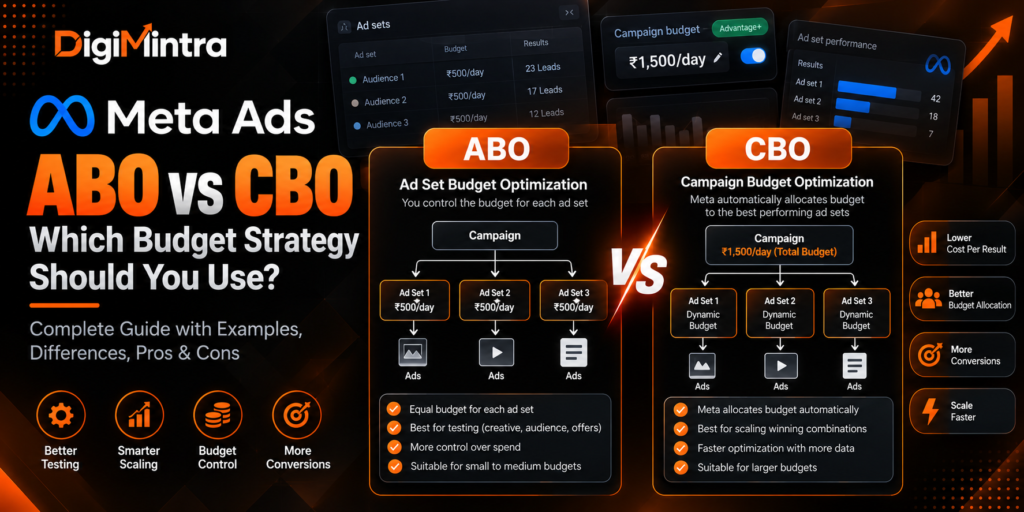
Every new Meta Ads campaign asks you the same question: should you set the budget at the campaign level and let the algorithm decide, or control each ad set’s spend yourself?
This is the ABO vs CBO decision — and it matters more than most advertisers realise, because it directly affects whether your tests produce reliable data, whether your budget reaches the right audiences, and whether Meta’s algorithm has the signals it needs to optimise efficiently.
The short answer is that both approaches have a role, and the most effective accounts use them for different purposes. This guide explains what each method does, what changed on the platform in 2026, when each one is appropriate, and how to move between them without disrupting campaign performance.
What ABO and CBO Actually Mean
ABO — Ad Set Budget Optimisation
ABO means setting a budget at the ad set level. Each ad set within your campaign receives its own daily or lifetime budget, which it spends independently of every other ad set. You decide how much each ad set gets.
In Meta Ads Manager, ABO is what you get when you turn off the Advantage campaign budget toggle at the campaign level. The interface does not use the label “ABO” — you simply leave budget control at the ad set level rather than the campaign level.
CBO — Campaign Budget Optimisation (Now Called Advantage Campaign Budget)
CBO means setting one budget at the campaign level and allowing Meta’s algorithm to distribute that budget across your ad sets in real time, based on where it predicts the most efficient results.
Meta rebranded CBO as Advantage campaign budget in Ads Manager. If you see that label on the campaign toggle, that is CBO. The underlying mechanism is the same — one campaign-level budget, algorithmically distributed. As of February 2026, this toggle is switched on by default for new Sales, Leads, and App Promotion campaigns in the unified campaign setup flow.
These two approaches represent a fundamental difference in who controls allocation: you, or Meta’s algorithm.
What Changed in 2026
In February 2026, Meta merged its separate manual and Advantage+ campaign creation flows into a single unified setup. The distinction between “manual campaigns” and “Advantage+ campaigns” as separate creation paths was removed. New campaigns now launch with Advantage campaign budget (CBO), Advantage+ Audience, and Advantage+ Placements switched on by default for the most common objectives.
This means that unless you actively turn off the Advantage campaign budget toggle during campaign setup, you are running CBO. ABO now requires a deliberate override — it is still fully available, but it is no longer the starting state for new campaigns.
Nothing about the fundamental mechanics changed. ABO still gives you ad set-level budget control. CBO (Advantage campaign budget) still distributes a campaign-level budget algorithmically. The key change is that the default shifted — and many advertisers who were previously running ABO may find their new campaigns defaulting to CBO without realising it.
The Core Difference: Control vs Automation
| Dimension | ABO (Ad Set Budget) | Advantage Campaign Budget / CBO |
|---|---|---|
| Where budget is set | Ad set level | Campaign level |
| Who allocates spend | You — each ad set spends its assigned amount | Meta’s algorithm — real-time reallocation across ad sets |
| Spend predictability | High — each ad set spends close to its budget | Lower — some ad sets may receive much more or less than expected |
| Testing control | Strong — each variant gets guaranteed exposure | Weaker — algorithm may starve new variants before they accumulate data |
| Scaling efficiency | Manual — you increase ad set budgets individually | Automatic — algorithm shifts spend toward better-performing ad sets |
| Learning phase | Each ad set learns independently | Algorithm can shift budget to help ad sets accumulate events faster |
| Operational complexity | Higher — more budgets to monitor and adjust | Lower — one budget to manage per campaign |
| Budget change risk | Changes over 20% can reset ad set learning | Campaign-level budget increases carry lower reset risk |
| Default in 2026 | No — requires manual toggle-off | Yes — on by default for new Sales, Leads, App campaigns |
How the Learning Phase Interacts With Both Approaches
Understanding the learning phase is essential to understanding the ABO vs CBO decision, because the two approaches interact with it very differently.
Meta’s learning phase is the period during which an ad set collects the conversion data needed to optimise delivery. According to Meta’s documented guidance, an ad set needs approximately 50 optimisation events within a 7-day window to exit the learning phase. Below that threshold, the ad set may enter “Learning Limited” status — meaning performance remains less stable and costs are typically higher.
This has a direct practical implication for budgeting. If your target cost per acquisition (CPA) is ₹2,000, the formula to estimate the minimum budget needed to exit learning is:
Minimum daily budget per ad set = (Target CPA × 50) ÷ 7

Example: ₹2,000 × 50 ÷ 7 = ₹14,286 per day per ad set
This is not an exact Meta requirement — it is a widely-used practitioner formula that reflects the documented 50-event threshold. Actual results vary based on campaign type, audience, creative, and other factors.
Learning Phase in ABO
In ABO, each ad set learns independently. Every ad set needs its own 50 events to exit learning. If you have four ad sets each with a ₹2,000 budget and a ₹2,000 CPA target, each ad set will need roughly ₹14,286 per day to exit learning in the standard 7-day window. Running four ad sets at ₹2,000/day each means each is significantly underfunded for fast learning — a common scenario that leads to prolonged Learning Limited status.
This is one reason why ABO campaigns with many ad sets can stall: the budget is distributed across too many independent learning units, and none of them accumulates events fast enough.
Learning Phase in Advantage Campaign Budget (CBO)
With Advantage campaign budget, Meta can direct more spend toward whichever ad set is accumulating conversion events most efficiently. This means one ad set may exit learning much faster than it would on a fixed ABO budget — while another may receive so little spend that it barely learns at all.
This algorithmic reallocation is a feature for scaling but a problem for testing: if you are trying to fairly evaluate two or three creative concepts, CBO may decide within 24–48 hours that one is already outperforming and direct 80% of spend there — before the others have had sufficient exposure to produce reliable data.
Important: Budget redistribution within an Advantage campaign budget campaign does not reset the learning phase for individual ad sets. Adding a new ad set to a running CBO campaign also does not restart learning for the existing ad sets. However, significant edits to an individual ad set — changing its creative, audience, or budget by more than 20% — can still reset that ad set’s learning independently.
When to Use ABO
ABO is the right choice when the purpose of the campaign requires controlled, comparable spend across variants. The clearest use cases are:
Creative Testing
When you want to compare creative concepts, hooks, formats, or messaging, each variant needs enough budget to produce meaningful data before any conclusion can be drawn. With ABO, you control how much each ad set or creative receives. With Advantage campaign budget, the algorithm may allocate 70–80% of spend to one variant within the first day, leaving the others with insufficient data — which produces a “winner” based on statistical noise rather than genuine performance.
For the same reason, creative testing within a single ad set (multiple ads, one ad set, ABO) is often more controlled than splitting creatives across multiple ad sets in a CBO campaign.
Audience Testing
When you need to compare how different audience approaches perform — broad vs interest-based vs custom audience — ABO ensures each audience segment receives comparable spend. This is the only way to produce a fair comparison between audiences that differ in size and CPM, since CBO would naturally favour the audience where the algorithm finds the cheapest conversions first.
Prospecting and Retargeting Running Simultaneously
Prospecting and retargeting campaigns have fundamentally different economics. Retargeting audiences convert at higher rates and lower costs — so if you combine prospecting and retargeting ad sets inside one Advantage campaign budget campaign, the algorithm will almost always funnel the majority of spend toward the retargeting audience, starving the prospecting campaign of the budget it needs to find new customers.
ABO — or separate campaigns — prevents this imbalance.
Fixed Strategic Budget Allocation
When your business strategy requires that a specific amount is spent on a specific product, market, funnel stage, or audience, ABO ensures that allocation is honoured. Advantage campaign budget will always allocate toward efficiency — which may not match your strategic intentions.
When to Use Advantage Campaign Budget (CBO)
Advantage campaign budget is the right choice when you have validated creative and audience combinations and want the algorithm to allocate efficiently among them. The clearest use cases are:
Scaling Proven Creative
Once you have identified a winning creative and audience combination through ABO testing, moving it into an Advantage campaign budget campaign allows Meta’s algorithm to find the cheapest conversions within that budget more efficiently than manual ad set-level control can. The algorithm adjusts in real time — something manual ABO budget management cannot match.
Multiple Warm Audiences With Similar Intent
When running multiple retargeting audiences of similar intent — for example, product page visitors (14 days), checkout visitors (7 days), and Instagram engagers (30 days) — Advantage campaign budget can balance spend across these audiences without requiring manual monitoring of each ad set’s performance.
Simplifying Campaign Management at Scale
For accounts managing many campaigns, reducing the number of individual ad set budgets to monitor and adjust lowers operational overhead. One campaign-level budget is easier to manage than twelve separate ad set budgets — provided the underlying creative and audiences have already been validated.
Faster Learning Phase Exit
When budget is limited relative to the number of ad sets, Advantage campaign budget can concentrate spend on the best-performing ad set, helping it accumulate the 50 conversion events needed to exit learning faster than if the same budget were split evenly across ad sets. This is a meaningful advantage when the account has limited total budget but needs learning phase stability.
The Test-Then-Scale Workflow
The most practical resolution to the ABO vs CBO debate is to stop treating it as a permanent either/or choice and instead use both methods for their respective strengths at different stages of the campaign lifecycle.
STAGE 1 — TESTING (ABO)
Campaign: ABO — ad set budget control
├── Ad Set 1: Creative concept A (controlled budget)
├── Ad Set 2: Creative concept B (controlled budget)
└── Ad Set 3: Creative concept C (controlled budget)

Each ad set receives comparable spend.
Each concept gets a fair opportunity to produce data.
Test duration: sufficient for each ad set to accumulate meaningful signal.
Goal: identify which concept performs strongest on business metrics.

          ↓

STAGE 2 — VALIDATION
Does the winning concept hold up over more data and time?
NO  → Continue testing
YES → Proceed to scaling

          ↓

STAGE 3 — SCALING (Advantage Campaign Budget)
Campaign: Advantage campaign budget (CBO)
├── Proven creative in proven audience
└── Budget set at campaign level — algorithm allocates

Do NOT flip the existing ABO testing campaign to CBO.
Create a new scaling campaign and move the winning creative there.
The ABO testing campaign continues running independently.

          ↓

STAGE 4 — ONGOING CREATIVE REFRESH
Testing campaign continues in parallel.
New creative concepts enter at Stage 1.
Winning concepts graduate to the scaling campaign.
Fatigued creatives are replaced.
This workflow reflects how experienced Meta Ads practitioners typically operate — not as official Meta guidance, but as a logical application of how each budget method functions. The key principle: ABO for testing, Advantage campaign budget for scaling, and never mix the two jobs in the same campaign.
Ad Set Spend Limits Inside CBO — A Middle Ground
Meta allows you to set minimum and maximum spend limits at the ad set level within an Advantage campaign budget campaign. This gives you a partial way to constrain the algorithm’s allocation without fully reverting to ABO.
- Minimum spend: Guarantees that an ad set receives at least a specified amount per day, preventing the algorithm from ignoring it entirely.
- Maximum spend: Caps an ad set’s spend, preventing the algorithm from concentrating all budget there.
However, use these controls deliberately and sparingly. Setting rigid spend limits significantly reduces the algorithm’s ability to optimise — which is the primary reason to use Advantage campaign budget in the first place. If you find yourself setting spend limits on most of your ad sets, ABO is probably the more appropriate structure for your current goal.
Spend limits are most useful when you have one dominant ad set that would otherwise absorb most of the campaign budget, but you have a specific strategic reason to maintain delivery across others.
Common Mistakes — and What They Actually Indicate
Switching an Existing ABO Campaign to Advantage Campaign Budget
What happens: Changing the budget level of a live campaign from ABO to Advantage campaign budget is a significant structural change. It typically disrupts delivery patterns and can cause ad sets to re-enter the learning phase. Any test data you were accumulating is difficult to interpret after the change.
Better approach: When you want to scale a proven concept into an Advantage campaign budget campaign, create a new campaign. Do not flip the testing campaign — leave it running as your ongoing test vehicle.
Using Advantage Campaign Budget for Testing Multiple Creatives Across Ad Sets
What happens: The algorithm will not give each creative equal time or spend. It will identify a likely winner early and allocate disproportionately toward it — often before any creative has had enough impressions to produce statistically reliable data. The resulting “winner” may be a product of the algorithm’s early predictions rather than genuine audience preference.
Better approach: Run creative tests with ABO so each concept gets comparable spend. Alternatively, test multiple creatives within a single ad set — Meta’s system will still allocate delivery across them, but you maintain control at the ad set budget level.
Running Prospecting and Retargeting Together in One Advantage Campaign Budget Campaign
What happens: Retargeting audiences convert more cheaply and consistently than cold prospecting audiences. In a shared Advantage campaign budget, the algorithm will predictably concentrate spend on retargeting — because that is where it finds the cheapest conversions. Prospecting, which needs budget to find new customers, gets starved.
Better approach: Keep prospecting and retargeting in separate campaigns, each with their own budget and objective. This preserves your ability to invest in new-customer acquisition even when retargeting shows better short-term efficiency metrics.
Judging a Test Too Quickly
What happens: A campaign paused after 48 hours with limited conversion data produces unreliable conclusions — especially if the ad set was still in the learning phase. One day’s performance is rarely representative, and early data variance is high regardless of whether you are using ABO or CBO.
Better approach: Allow campaigns sufficient time and budget to accumulate meaningful data before drawing conclusions. Understand your conversion lag — high-consideration purchases may take several days to complete after the initial click. Evaluate results after the learning phase has stabilised, not during it.
Assuming Budget Strategy Will Fix a Weak Creative or Broken Tracking
What happens: Switching from ABO to CBO (or vice versa) will not rescue a campaign with poor creative, an irrelevant offer, a broken pixel, or a landing page that does not convert. Budget strategy determines how spend is allocated — it does not determine whether the underlying elements of the campaign are effective.
Better approach: Before changing budget strategy, verify that tracking is working, the landing page is converting organic traffic at a reasonable rate, and the creative has been validated in some form. Budget optimisation works best when it has good raw materials to work with.
Quick Decision Reference
| Situation | Recommended Approach | Reason |
|---|---|---|
| Testing new creative concepts | ABO | Each concept needs guaranteed, comparable spend to produce fair data |
| Testing different audience approaches | ABO | Prevents algorithm from biasing toward the easiest-to-reach audience |
| Scaling a validated creative + audience combination | Advantage campaign budget (CBO) | Algorithm allocates efficiently without manual intervention |
| Running prospecting and retargeting together | Separate campaigns (either budget type) | Retargeting economics will dominate shared CBO — prospecting gets starved |
| Limited budget, multiple ad sets struggling to exit learning | Advantage campaign budget (CBO) or consolidate ad sets | Algorithm can concentrate spend to help best-performing ad set accumulate events faster |
| Strategic budget allocation required (by product, market, funnel stage) | ABO | Algorithm will optimise for efficiency, not strategic intent |
| Simplifying management of proven, scaled campaigns | Advantage campaign budget (CBO) | One budget to monitor per campaign; algorithm handles reallocation |
| New campaign in 2026 (default) | Advantage campaign budget (CBO) — toggle off for ABO | Meta defaults to Advantage campaign budget for new Sales, Leads, App campaigns |
Frequently Asked Questions
Is CBO the same as Advantage campaign budget?
Yes. Meta rebranded Campaign Budget Optimisation (CBO) as Advantage campaign budget. The underlying mechanism is the same: one budget set at the campaign level, distributed across ad sets by Meta’s algorithm based on real-time performance signals. You may see either label depending on your account and region, but they refer to the same feature.
Can I still use ABO in 2026?
Yes. ABO is fully available. Since February 2026, new Sales, Leads, and App Promotion campaigns default to Advantage campaign budget — but you can turn this toggle off during campaign setup to regain ad set-level budget control. ABO has not been removed or deprecated.
Does CBO reset the learning phase when budget is redistributed?
No. Budget redistribution within an Advantage campaign budget campaign does not reset learning for individual ad sets. Increasing the campaign-level budget also carries lower reset risk than increasing individual ad set budgets in ABO, which can reset learning if the increase exceeds approximately 20%. However, significant edits to an individual ad set — such as changing the creative, audience, or budget at the ad set level — can still reset that ad set’s learning independently.
Should I run ABO and CBO campaigns at the same time?
Yes — and this is the most effective approach. A permanent ABO testing campaign runs alongside an Advantage campaign budget scaling campaign. The testing campaign identifies winning creative and audience combinations. The scaling campaign deploys budget behind validated winners. Winners from the ABO campaign are moved to the CBO scaling campaign; the ABO campaign continues running with new test candidates.
Which is better for a beginner: ABO or CBO?
Neither is universally better. For a beginner with a small budget and a clear conversion event, a single Advantage campaign budget campaign with one or two ad sets and three to five creative variations is often the simplest starting point — because it reduces operational complexity and allows Meta’s algorithm to find the most efficient delivery. ABO becomes more important once you are actively testing multiple concepts and need comparable data from each.
Can I use spend limits to make CBO behave more like ABO?
Partially. Meta allows minimum and maximum spend limits at the ad set level within an Advantage campaign budget campaign. However, heavily constraining the algorithm with spend limits removes most of the efficiency benefit of Advantage campaign budget. If you need precise control over how much each ad set spends, ABO is more appropriate than a heavily limited CBO campaign.
Why does my CBO campaign keep putting all the budget into one ad set?
This is the algorithm working as designed — it found an ad set where it predicts the cheapest conversions and is concentrating spend there. If this does not match your strategic intention, consider: (1) whether the favoured ad set genuinely is your best performer, in which case this is desirable; (2) whether you actually need comparable spend across ad sets, in which case ABO is more appropriate; or (3) whether ad set spend limits can address the imbalance if you have a specific strategic reason to maintain spend on other ad sets.
The Practical Takeaway
ABO vs CBO is not really a debate about which method is better. It is a question about what you are trying to accomplish right now.
If you are trying to learn — which creative concept works, which audience responds, which offer converts — you need controlled, comparable spend across variants. That requires ABO.
If you have already found what works and you want to deploy more budget efficiently behind it, Meta’s algorithm is better at real-time allocation than any manual adjustment you can make. That is what Advantage campaign budget (CBO) is built for.
Use ABO to generate the evidence. Use Advantage campaign budget to act on it. Keep both running simultaneously — one testing, one scaling — and treat the handoff between them as a deliberate strategic decision based on validated performance, not a reaction to a few days of data.
For a complete picture of how budget strategy fits into the broader campaign architecture, see our guide to Meta Ads campaign structure and testing frameworks. If you are building out a retargeting strategy and need to think about how prospecting and retargeting budgets should interact, the Meta Ads retargeting strategy guide covers that decision in detail. For budget sizing specific to the Indian market, the Meta Ads budget guide for India includes cost benchmarks and learning-phase budget formulas.