
Most advertisers change the creative, the audience, the offer, the budget, and the funnel — all at once — then wonder why results are unpredictable. When everything moves simultaneously, there is no way to know what caused the result.
This is the central problem that campaign structure solves. Structure is not about organising Ads Manager neatly. It is about creating the conditions in which you can actually learn what works — which creative, which audience, which offer, which conversion path — and then scale the combinations that perform.
The principle is simple: if you want to know what caused a result, isolate the variable you are testing and hold everything else constant.
This guide explains exactly how to structure Meta Ads campaigns depending on what you are trying to test — with practical frameworks, decision tables, and real examples for 2026.
What Is Meta Ads Campaign Structure?
Meta Ads campaign structure refers to how an advertiser organises their campaigns, ad sets, and ads within Meta Ads Manager. The structure controls budget allocation, audience targeting, delivery optimisation, and how data is segmented across the account.
A well-designed structure makes testing possible. A poorly designed structure makes learning nearly impossible — even with significant spend.
Campaign → Ad Set → Ad: The Three Levels
| Level | Controls | Key Settings |
|---|---|---|
| Campaign | Objective, budget strategy | Objective (Sales, Leads, Awareness, Traffic, Engagement), Advantage+ campaign budget on/off, campaign-level spend limits |
| Ad Set | Audience, placements, optimisation, budget (if ABO) | Audience targeting, Advantage+ Audience on/off, placements (Advantage+ or manual), conversion location, optimisation event, schedule, ad set budget |
| Ad | Creative, copy, destination | Media (video, image, carousel), primary text, headline, description, CTA, destination URL or instant form |
Understanding what each level controls is essential before designing any testing structure. The campaign level sets the overall objective. The ad set level determines who sees the ad and how the budget is managed. The ad level is where the creative lives.
What Has Changed in 2026: Key Meta Platform Updates
Before applying any campaign structure framework, it helps to understand how the platform has evolved — because some structures that were standard practice two or three years ago may now work differently.
- Advantage+ campaign budget is the current name for what was formerly called Campaign Budget Optimization (CBO). Meta has defaulted new campaigns to this setting. Turning it off gives you ad set-level budget control — what has traditionally been called ABO.
- Advantage+ Audience is Meta’s AI-driven targeting mode. When enabled, your targeting inputs become “suggestions” rather than strict constraints. The system can expand delivery beyond your defined parameters to find higher-converting users. Location, minimum age, language, and exclusions remain respected.
- Advantage+ Placements allows Meta to automatically select the best-performing placements across Facebook, Instagram, Stories, Reels, Messenger, and Audience Network.
- Detailed targeting exclusions for interests were removed in March 2025. Standard exclusions (such as excluding existing customers) remain available through custom audiences.
- Advantage+ Sales campaigns (formerly Advantage+ Shopping) and Advantage+ Leads are now fully automated campaign types with minimal manual controls — distinct from standard manual campaigns with Advantage+ features toggled on.
- The manual vs Advantage+ toggle in the campaign creation UI was replaced with a simpler interface. When you combine broad targeting, Advantage+ placements, campaign-level budget, and a purchase or lead event, the system enters a highly automated mode.
These changes affect how campaign structure interacts with Meta’s AI delivery system — and they change how testing should be approached.
The Golden Rule of Meta Ads Testing
Change one major variable at a time.
This is the principle that determines whether a test produces actionable learning or ambiguous noise. Consider two ads running simultaneously:
Ad A: Broad audience + testimonial video + free consultation offer + landing page
Ad B: Interest-based audience + static image + discount offer + WhatsApp
If Ad A outperforms Ad B, what caused it? Was it the audience? The format? The offer? The conversion path? There is no way to know — because four variables changed simultaneously.
Here is how the golden rule applies to each test type:
| Test Type | Change This | Keep These Constant |
|---|---|---|
| Creative | Creative (hook, format, concept) | Audience, offer, landing page, budget approach |
| Audience | Audience / targeting approach | Creative, offer, landing page |
| Offer | Offer / value proposition | Audience, creative framework |
| Funnel | Conversion path | Core business proposition, traffic source, comparable audience |
The 4 Main Meta Ads Testing Structures
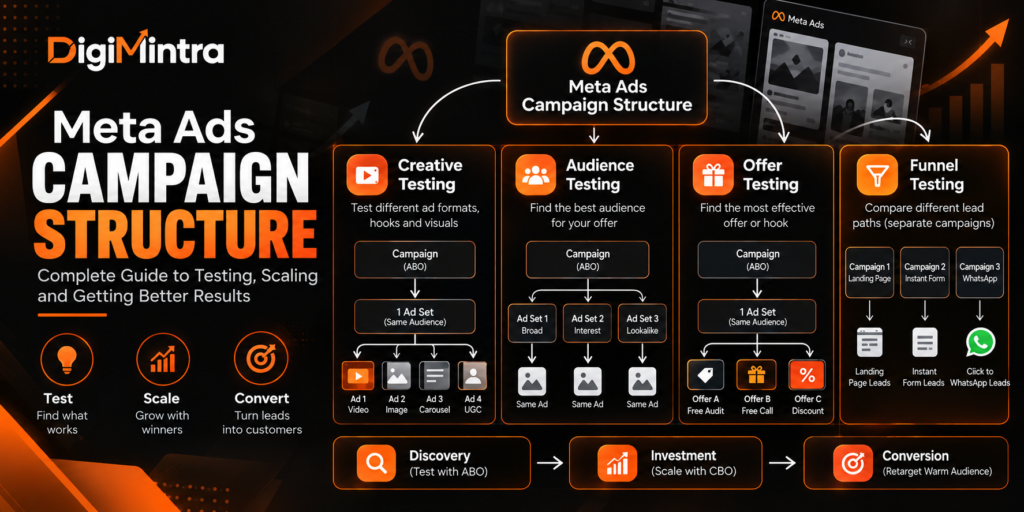
1. Creative Testing
Objective: Identify which creative concept, hook, format, message, or execution produces stronger results.
Core rule: Keep the audience as consistent as reasonably possible. Change the creative.
In 2026, creative is arguably the highest-leverage variable in Meta advertising. With Advantage+ Audience handling much of the targeting optimisation automatically, the quality and diversity of your creative library has become the primary way to guide Meta’s AI toward the right audience segment. As one widely-cited practitioner framework puts it: “creative is the new targeting.”
Recommended structure for creative testing:
Campaign (ABO – ad set budget control)
└── Ad Set (controlled audience)
    ├── Ad 1 – Testimonial Video
    ├── Ad 2 – Problem/Solution Video
    ├── Ad 3 – Founder Story Video
    ├── Ad 4 – Static Image
    └── Ad 5 – Carousel
By keeping all ads inside the same ad set with the same audience parameters, each creative receives delivery from the same audience pool — making the comparison more controlled. This is a strategic testing framework, not an official Meta requirement.
Campaign (ABO – ad set budget control)
└── Ad Set (controlled audience)
    ├── Ad 1 – Testimonial Video
    ├── Ad 2 – Problem/Solution Video
    ├── Ad 3 – Founder Story Video
    ├── Ad 4 – Static Image
    └── Ad 5 – Carousel
What you can test at the creative level:
- Hook / opening 3 seconds
- Creative angle (pain-point, curiosity, outcome, testimonial, contrarian)
- Visual format (video vs static vs carousel vs Reels-style)
- Creator type (brand, founder, UGC, influencer)
- Message (benefit, feature, price, proof, objection handling)
- CTA text and placement
- Primary text / copy
- Headline
- Thumbnail
Important: Testing too many unrelated variables within a single test makes it harder to understand why one ad performed better. The most useful creative tests have a clear hypothesis — for example, “Does a pain-point hook outperform a curiosity hook for this audience?”
Creative Test Matrix:
| Test | Variable | Kept Constant | Example |
|---|---|---|---|
| Hook test | Opening hook | Same concept, same audience | Pain-point hook vs curiosity hook |
| Format test | Ad format | Same message, same audience | Video vs static vs carousel |
| Creator test | Who appears / narrates | Same hook, same offer | Founder vs UGC creator |
| CTA test | Call to action | Same creative body | “Book Now” vs “Get Your Free Audit” |
2. Audience Testing
Objective: Identify which audience strategy produces stronger business outcomes.
Core rule: Keep the creative consistent. Change the audience variable.
Important 2026 context: Audience testing in Meta Ads has changed significantly. With Advantage+ Audience enabled (the default in many campaign types), targeting inputs function as “suggestions” — the system may expand delivery beyond your defined parameters. This means that when Advantage+ Audience is active, audience differentiation between ad sets can be less distinct than it appears in the UI. If you need controlled audience testing, verify whether Advantage+ Audience expansion is active and consider whether it affects the validity of your test.
Recommended structure for audience testing:
Campaign (ABO — ad set budget control)
├── Ad Set 1: Broad (minimal targeting constraints)
│   ├── Ad A
│   ├── Ad B
│   └── Ad C
├── Ad Set 2: Interest-based targeting
│   ├── Ad A
│   ├── Ad B
│   └── Ad C
└── Ad Set 3: Custom / Lookalike audience
    ├── Ad A
    ├── Ad B
    └── Ad C
Using identical creatives across all ad sets isolates the audience variable and makes the comparison more meaningful.
Audience types available in 2026:
- Broad targeting — minimal constraints, letting Meta’s AI find the best users. This has become the recommended approach for many accounts with sufficient conversion volume.
- Detailed targeting — interests, demographics, and behaviours. Still available but increasingly treated as “suggestions” when Advantage+ Audience is active.
- Custom audiences — website visitors, customer lists, video viewers, form openers, engagers. Still a strong signal source.
- Lookalike audiences — similar to your best customers. Still available in Meta Ads Manager.
- Advantage+ Audience — AI-driven mode where your inputs become suggestions and the system optimises delivery autonomously.
Why cheapest CPM is not the best audience signal: An audience that delivers a low CPM but poor downstream conversion rate may cost more per qualified lead or sale. Audience testing should be evaluated using business outcomes — cost per qualified lead, sales rate, revenue — not only front-end metrics.
3. Offer Testing
Objective: Identify which offer or value proposition produces stronger business results.
Core rule: Keep the audience consistent. Change the offer.
Offers are typically communicated through the creative and copy rather than through separate audience segments. This means offer testing can often run within the same ad set, with different ads presenting different offers to the same audience.
Example structure:
Campaign
└── Ad Set (same audience)
    ├── Ad 1 — Free Consultation
    ├── Ad 2 — Free Audit
    └── Ad 3 — Free Strategy Session
The key distinction between creative testing and offer testing:
| Test Type | What Changes | What Stays the Same |
|---|---|---|
| Creative test | Format, hook, visual style | Same offer presented differently |
| Offer test | The core value proposition | Controlled creative execution — ideally same format and approach |
If you test different offers using entirely different creative executions, you cannot separate the effect of the offer from the effect of the creative. For a cleaner offer test, keep the creative framework as consistent as possible and change only the offer being communicated.
Metrics for evaluating offer tests:
The strongest offer is not necessarily the one that generates the most leads at the lowest cost. Evaluate offers using: click-through rate, landing page conversion rate, lead cost, lead quality (qualification rate), sales rate, revenue, and customer acquisition cost. The offer that produces more qualified leads at a slightly higher CPL may outperform the offer that produces more volume at a lower cost.
4. Funnel / Lead Path Testing
Objective: Identify which conversion pathway produces the best business outcomes.
Funnel testing compares fundamentally different conversion paths — not just different creatives or audiences, but different ways of capturing or converting a prospect.
Path A: Ad → Landing Page → Form → Thank You Page
Path B: Ad → Meta Instant Form → CRM → Sales Follow-up
Path C: Ad → WhatsApp → Sales Conversation → Purchase
Path D: Ad → Website → Product Page → Purchase
Each conversion path has different characteristics:
| Conversion Path | Typical Strengths | Typical Considerations |
|---|---|---|
| Landing Page + Form | High control over experience, good data quality | More friction, requires landing page quality |
| Meta Instant Form | Low friction, high volume, native to Meta | Often lower lead quality, pre-filled data needs verification |
| WhatsApp / Click-to-Chat | High intent signal, direct sales conversation | Requires sales team capacity, harder to track at scale |
| Direct Website Purchase | Clean attribution, no middle step | Higher conversion barrier, needs pixel + Conversions API |
Why separate campaigns are strategically useful for funnel testing: Different conversion paths use different Meta campaign objectives and optimisation events. A campaign optimising for instant form leads will behave differently from one optimising for website purchases. Keeping these in separate campaigns makes comparison cleaner and prevents the algorithm from mixing signals between incompatible conversion events.
Warning: Do not compare funnels using only front-end metrics. The funnel that produces the cheapest leads may not produce the most revenue. Always trace results down to qualified leads, sales conversations, and revenue before concluding which path wins.
ABO vs Advantage+ Campaign Budget (formerly CBO): The 2026 Framework
This is one of the most consequential structural decisions in Meta Ads — and the terminology has changed.
- ABO (Ad Set Budget Optimisation): You set a budget at the ad set level. Each ad set receives its allocated budget regardless of relative performance. This gives you explicit control over how much each test variant spends.
- Advantage+ campaign budget (formerly CBO — Campaign Budget Optimisation): One budget is set at the campaign level. Meta’s algorithm distributes it across ad sets in real time based on predicted performance. This means some ad sets may spend heavily while others receive minimal delivery.
| Feature | ABO (Ad Set Budget) | Advantage+ Campaign Budget (formerly CBO) |
|---|---|---|
| Budget control | Ad set level | Campaign level |
| Best for testing | ✓ Strong — each variant gets guaranteed exposure | ⚠ Risky — algorithm may starve new variants before they get data |
| Best for scaling | Situational | ✓ Often stronger — algorithm finds cheapest conversions |
| Variable isolation | Stronger | Weaker — budget allocation can confound results |
| Algorithmic allocation | More limited | Greater — algorithm decides distribution |
| Control | Higher | Lower |
The practical recommendation: Use ABO (ad set budget control) for controlled testing — when you need every variant to receive comparable spend to produce a fair verdict. Use Advantage+ campaign budget for scaling — when you have proven winning combinations and want Meta’s algorithm to allocate spend toward the most efficient opportunities.
This distinction is a strategic framework, verified against current 2026 Meta platform behaviour. It is not an official Meta rule, and there may be cases — particularly for experienced advertisers with large accounts and Advantage+ Sales campaigns — where the approach differs.
One important caution: Avoid switching an existing ABO testing campaign to Advantage+ campaign budget mid-flight. Doing so resets learning across all ad sets and undermines the test you have already built.
The 3-Role Meta Ads Account Structure
A well-structured Meta Ads account typically serves three distinct strategic roles. Keeping these separate prevents budget and data from becoming mixed across fundamentally different objectives.
META ADS ACCOUNT
│
├── ROLE 1: TESTING / DISCOVERY
│   ├── Creative Test Campaign
│   ├── Audience Test Campaign
│   └── Offer Test Campaign
│
├── ROLE 2: SCALING / INVESTMENT
│   └── Proven Winning Combinations
│       (Higher budget, Advantage+ campaign budget)
│
└── ROLE 3: RETARGETING / CONVERSION
    ├── Website Visitors
    ├── Video Viewers / Engagers
    ├── Lead Form Openers
    └── Warm Custom Audiences
Role 1 — Testing / Discovery
Purpose: Discover which creatives, audiences, offers, and messages produce results. This campaign layer should run continuously — not just when launching something new. Creative fatigue is real, and a permanent testing pipeline keeps the account fed with validated candidates.
Budget approach: ABO is typically the right structure here. Each test variant receives a predictable budget, preventing the algorithm from prematurely concentrating spend on one option before others have had a fair read.
Key principle: Every ad in the testing layer should have a clear hypothesis — what you expect to learn and why.
Role 2 — Scaling / Investment
Purpose: Deploy more budget behind combinations that have been validated in the testing layer. Scaling is not simply running the same campaigns with a larger budget — it requires moving proven creative and audience combinations into a structure designed for efficient delivery.
Budget approach: Advantage+ campaign budget is often a strong choice here. Once a creative is proven, the algorithm can find the cheapest and most efficient delivery path without needing manual ad set-level control.
What scaling is not: Scaling is not duplicating every ad set and doubling the budget. Premature scaling of unvalidated ads is one of the most common ways Meta Ads budgets are wasted. Validate before you scale. Monitor performance carefully after budget increases — significant budget changes can affect delivery patterns and temporarily disrupt results.
Role 3 — Retargeting / Conversion
Purpose: Re-engage people who have already interacted with the business — warming them toward conversion or encouraging repeat purchase.
Retargeting audiences available in 2026:
- Website visitors (all pages, specific pages, product viewers)
- Video viewers (by percentage watched)
- Instagram and Facebook engagers
- Lead form openers and submitters
- Customer lists (uploaded via CSV or CRM integration)
- App users
- WhatsApp business engagers
Exclusions: Exclude existing purchasers from campaigns designed to acquire new customers, where appropriate. Failing to apply correct exclusions can waste budget on audiences who have already converted and distort performance metrics.
How Meta’s AI and Automation Interact With Campaign Structure
Campaign structure directly affects the quantity and quality of data available to Meta’s delivery system. Meta’s AI — powered by what the company refers to as the Andromeda engine for ad ranking and delivery — uses conversion signals, audience patterns, and creative performance data to optimise delivery. The way you structure campaigns determines what data the system has access to and how it can act on it.
Key documented platform behaviours relevant to structure decisions:
- Learning phase: Meta states that ad sets enter a learning phase when first launched or after significant changes, during which delivery may be less stable. Structural changes — adding/removing ad sets, changing budgets significantly, changing optimisation events — can trigger re-entry into learning. Over-segmented accounts with many small ad sets may struggle to exit learning consistently.
- Consolidation and data pooling: Fewer, larger ad sets generally give the algorithm more signal to work with. Highly fragmented structures — many small campaigns and ad sets — can result in slower learning, less stable delivery, and harder-to-interpret data. This is why Meta and many practitioners recommend consolidation as a default approach, particularly for smaller budgets.
- Advantage+ Audience expansion: When Advantage+ Audience is active, the system can expand beyond your defined targeting. This is documented Meta behaviour — your inputs become “suggestions.” This affects audience testing: ad sets that appear to have different audiences in the UI may overlap significantly in actual delivery.
- Creative rotation: Within an ad set, Meta will allocate delivery among ads based on predicted performance. This means some creatives may receive much more delivery than others — which is the intended behaviour in scaling but may not be ideal in a testing context where you need comparable data for each variant.
Important note: Meta does not publicly disclose the exact mechanics of its delivery algorithm. The above reflects documented platform behaviour and widely-observed patterns — not proprietary algorithmic detail.
Consolidate vs Separate: A Decision Framework
One of the most common structural mistakes is creating separate campaigns and ad sets for reasons that could be managed within a more consolidated structure. Excessive segmentation fragments data, slows learning, increases management complexity, and can cause ad sets to compete against each other in the same auction.
| Consider Consolidating When… | Consider Separating When… |
|---|---|
| Same objective and conversion event | Different campaign objectives (e.g., Leads vs Sales) |
| Similar audiences at the same funnel stage | Fundamentally different conversion paths (funnel testing) |
| Same business goal | Different countries or languages |
| Budget is limited — more data per ad set improves learning | Different budget requirements or business economics |
| No meaningful reason for separation | Different product categories with distinct economics |
| You want faster learning phase exit | Controlled A/B testing requiring clean data isolation |
Consolidation does not mean removing all structure. It means avoiding unnecessary duplication and ensuring that every campaign and ad set exists for a specific strategic reason — not for organisational tidiness.
How to Know When a Test Has Won
There is no universal rule such as “pause after 1,000 impressions” or “winner needs 50 conversions.” Sufficient evidence for declaring a winner depends on your specific situation.
The right framework considers:
- Spend: Has each variant received enough budget to produce meaningful data?
- Conversion volume: Have you collected enough conversion events to draw a directional conclusion?
- Conversion lag: For products with longer decision cycles, results may take days to appear after the ad impression.
- Statistical confidence: Higher confidence requires more data. Early leads in a test often change direction with more data.
- Business economics: The right threshold is specific to your cost per acquisition targets and margins.
Distinguish between stages of evidence:
- Early signal: One variant is trending ahead — interesting, but not actionable yet.
- Directional signal: The pattern is consistent across enough data to warrant attention. Worth watching but not scaling.
- Confirmed performance: Results are consistent, conversion volume is meaningful, and the winner holds up across time.
- Scalable winner: Confirmed performance plus validation that the result holds at higher spend. Only at this stage should aggressive scaling begin.
How to Scale Winning Ads
Scaling is not a single action. It is a managed process that follows validation.
TEST (ABO testing campaign)
↓
IDENTIFY WINNERS (directional signal)
↓
VALIDATE (confirmed performance over sufficient data)
↓
MOVE WINNERS INTO SCALING STRUCTURE
(Advantage+ campaign budget, proven ad set)
↓
INCREASE BUDGET CAREFULLY
(Gradual increases — significant budget jumps can disrupt delivery)
↓
MONITOR BUSINESS OUTCOMES
(Not just CTR — track CPA, ROAS, revenue)
↓
INTRODUCE NEW CREATIVE
(Testing layer continues independently)
↓
CONTINUE TESTING
(Creative fatigue is real — the testing pipeline never stops)
Creative fatigue: Even the best-performing creative will decline over time as audiences become overexposed. This is one of the most common reasons why scaling campaigns plateau. The solution is a continuous creative testing pipeline running in parallel with the scaling layer — not reacting to fatigue after it has already affected results.
Scaling approaches:
- Vertical scaling: Increasing budget on a proven campaign or ad set.
- Horizontal scaling: Expanding to new audiences, new placements, or new geographies using the same proven creative.
- Creative expansion: Introducing new creative variations to proven audiences.
Common Meta Ads Campaign Structure Mistakes
1. Testing Multiple Variables Simultaneously
Problem: Changing audience, creative, offer, and landing page at the same time. Consequence: Cannot identify what caused the result. Solution: Isolate one major variable per test.
2. Creating Too Many Campaigns and Ad Sets
Problem: Building separate campaigns for every minor variation. Consequence: Data fragmentation, slow learning, high management overhead, potential auction overlap. Solution: Consolidate where no meaningful reason for separation exists.
3. Judging Tests Too Early
Problem: Pausing ads after 24–48 hours with minimal data. Consequence: Random early variance produces false winners and losers. Solution: Allow sufficient time and budget for each variant before drawing conclusions.
4. Using CPL as the Only Success Metric
Problem: Optimising for the cheapest lead cost without tracking lead quality or sales rate. Consequence: High volume of unqualified leads at low cost — often more expensive in total than fewer, better-qualified leads. Solution: Track and evaluate qualified lead rate, sales rate, revenue, and CAC.
5. Scaling Before Validating
Problem: Significantly increasing budget as soon as an ad shows early positive signals. Consequence: Scaling a result that was statistical noise — and wasting budget. Solution: Validate winners at the current budget level before scaling meaningfully.
6. Stopping Creative Testing After One Winner
Problem: Finding a winning creative and stopping all testing. Consequence: Creative fatigue eventually degrades performance with no replacement ready. Solution: Keep the testing layer running continuously, even during successful scaling periods.
7. Testing Without a Clear Hypothesis
Problem: Launching multiple ads with no clear question being answered. Consequence: Even if one ad outperforms another, there is no transferable learning. Solution: Every test should have a specific hypothesis — “I believe X will outperform Y because Z.”
8. Incorrect or Missing Exclusions
Problem: Showing prospecting ads to existing customers, or retargeting ads to people who already converted. Consequence: Budget waste, inflated CPL numbers, poor audience experience. Solution: Apply appropriate exclusions at the ad set level using custom audiences.
9. Changing Budgets Too Frequently
Problem: Making frequent significant budget changes to campaigns. Consequence: Disrupts delivery patterns and can trigger re-entry into the learning phase. Solution: Make budget changes incrementally and allow time for delivery to stabilise.
10. Comparing Different Funnels on Front-End Metrics Only
Problem: Declaring a funnel winner based on CPL alone. Consequence: A funnel that produces cheaper leads may produce fewer sales. Solution: Evaluate funnels on qualified leads, sales rate, revenue, and business economics.
Hypothetical Business Examples
The following are illustrative hypothetical scenarios — not DigiMintra client case studies.
Local Service Business (Home Renovation)
| Element | Detail |
|---|---|
| Business goal | Generate qualified consultation requests |
| Testing objective | Which creative concept produces more qualified leads? |
| Campaign structure | One testing campaign (ABO) |
| Ad set structure | One ad set — local geographic targeting |
| Ads | Before/after video, testimonial video, founder story |
| Success metric | Qualified consultation booking rate, not raw CPL |
| Scaling structure | Winner moved to Advantage+ campaign budget campaign |
D2C E-commerce Brand
| Element | Detail |
|---|---|
| Business goal | Profitable customer acquisition at target ROAS |
| Testing objective | Which creative hook drives the strongest purchase rate? |
| Campaign structure | Testing: ABO. Scaling: Advantage+ campaign budget (or Advantage+ Sales) |
| Ad set structure | Testing: one controlled ad set with broad targeting |
| Ads | 5 creative variations — different hooks, same core offer |
| Success metric | ROAS, CPA, revenue |
B2B Lead Generation (SaaS / Professional Services)
| Element | Detail |
|---|---|
| Business goal | Qualified sales-ready leads |
| Testing objective | Instant form vs landing page — which produces better-quality leads? |
| Campaign structure | Two separate campaigns — different conversion paths |
| Success metric | Qualified lead rate, sales conversion rate, pipeline value |
| What to avoid | Judging on CPL alone — instant forms often produce cheaper but lower-quality leads |
Meta Ads Testing Decision Tree
START: What are you trying to learn?

├── CREATIVE PERFORMANCE?
│   → Keep audience constant
│   → Run multiple creative variations in same ad set (ABO)
│   → Evaluate: CTR, CPA, ROAS, CPC
│
├── AUDIENCE PERFORMANCE?
│   → Keep creative constant (same ads in each ad set)
│   → Test different audience approaches across ad sets
│   → Evaluate: CPM, CPA, lead quality, revenue
│
├── OFFER PERFORMANCE?
│   → Keep audience constant
│   → Test different offers in same ad set
│   → Evaluate: CTR, conversion rate, lead quality, sales rate
│
└── FUNNEL / CONVERSION PATH?
    → Keep proposition comparable
    → Separate campaigns per conversion path
    → Evaluate: CPL, qualified lead rate, sales rate, revenue

          ↓

Did you identify a winner with sufficient data?

NO → Continue testing. Check: Was enough budget allocated? Was the test long enough?
      Did multiple variables change? Diagnose before restarting.

YES → Validate (is the result consistent over more time/spend?)

          ↓

Validated?

NO → Continue testing

YES → Move winner to scaling structure
      → Gradually increase budget
      → Monitor business outcomes carefully
      → Continue creative testing in parallel
      → Refresh creatives as fatigue appears
Quick Reference: Testing Structure Summary
| Testing Goal | Structure | Variable Changed | Kept Constant | Budget Approach | Primary Success Metric |
|---|---|---|---|---|---|
| Creative testing | 1 Campaign → 1 Ad Set → Multiple Ads | Creative | Audience, offer, landing page | ABO | CPA, ROAS, CTR |
| Audience testing | 1 Campaign → Multiple Ad Sets → Same Ads | Audience / targeting | Creative, offer, landing page | ABO | CPA, CPL, lead quality |
| Offer testing | 1 Campaign → 1 Ad Set → Multiple Ads | Offer / value proposition | Audience, creative framework | ABO | Conversion rate, sales rate |
| Funnel testing | Separate campaigns per path | Conversion path | Core proposition, comparable audience | ABO per campaign | Qualified leads, revenue, CAC |
| Scaling | 1 Campaign → Proven ad set(s) | Budget (increasing) | Proven creative + audience | Advantage+ campaign budget | ROAS, CPA, revenue |
Frequently Asked Questions
What is the difference between a campaign, ad set, and ad in Meta Ads?
The campaign sets your objective (Sales, Leads, Awareness) and budget strategy. The ad set controls who sees your ad — audience, placements, optimisation event, and budget when using ABO. The ad is the creative itself — video, image, copy, headline, CTA, and destination.
Should I use ABO or Advantage+ campaign budget for testing?
ABO (ad set budget control) is generally more appropriate for testing because it guarantees that each variant receives comparable exposure. Advantage+ campaign budget can concentrate spend on one variant before others have received enough data for a fair comparison — which undermines the test. Use Advantage+ campaign budget for scaling proven combinations.
How many ads should I test at once?
This depends on your budget and the test objective. More variants require more budget to produce meaningful data on each. A small budget spread across ten creative variants may not generate enough data on any individual ad to draw conclusions. Three to five well-differentiated variants in a focused test will typically produce clearer learning than ten loosely defined variations.
How long should I run a Meta Ads test?
There is no universal timeframe. The right duration depends on your conversion volume, spend, and conversion lag. Tests with few daily conversions need more time. Tests for high-ticket products with long decision cycles need longer windows. A general practice is to avoid making decisions during the learning phase (typically the first several days after launch) and to collect enough conversions to identify a consistent pattern.
Should I separate prospecting and retargeting campaigns?
Generally yes — prospecting and retargeting serve different strategic purposes, use different audiences, and often require different creatives and messaging. Keeping them separate allows for cleaner budget allocation and clearer performance measurement for each funnel stage.
Can I test creatives inside an Advantage+ Sales campaign?
Advantage+ Sales campaigns are designed for scaling and automated optimisation, not controlled testing. For structured creative testing where you need comparable exposure across variants, a manual campaign with ABO is typically more appropriate. Advantage+ Sales campaigns make many decisions automatically, which can make controlled variable isolation more difficult.
What is creative fatigue and how do I manage it?
Creative fatigue occurs when an audience has been exposed to the same ad too many times, leading to declining CTR, rising CPM, and worsening CPA. The solution is a continuous creative testing pipeline — regularly introducing new creative candidates into the testing layer so that replacements are ready before fatigue sets in significantly.
How many campaigns should a Meta Ads account have?
There is no universally correct number. The right number is determined by how many distinct strategic roles, objectives, or testing structures you need to run. For most advertisers, a Testing campaign (ABO), a Scaling campaign (Advantage+ budget), and a Retargeting campaign represents a practical baseline. Additional campaigns should be created only when there is a clear strategic reason — not for organisational tidiness.
Conclusion
Campaign structure is not an administrative exercise. It is a testing framework that determines whether you can learn what is actually working in your Meta Ads account.
The central principle applies regardless of budget, industry, or business model: decide what you are trying to test before you build the campaign, then structure it so only that variable changes.
In 2026, with Meta’s AI systems handling more targeting and delivery decisions automatically, the advertiser’s role has shifted toward controlling what the AI has to work with — high-quality, diverse creative, clear conversion signals, and well-structured data. Campaign structure is the foundation that makes all of that possible.
Use the frameworks in this guide as a starting point. Test one variable at a time. Validate before scaling. Keep the creative pipeline running continuously. Evaluate tests on business outcomes, not just front-end metrics.
For more on Meta Ads strategy and optimisation, see our guides on AI for Meta Ads, Meta Ads budgeting, and Meta Ads vs Google Ads. If you are exploring the broader performance marketing picture, our performance marketing agencies guide and the AI vs human ad copy case study are worth reading alongside this article.